PPC vs. SEO for Law Firms: Which One Should You Prioritize?

law firm PPC vs SEO which is better, sequencing question for law firm marketing


This question gets asked at every law firm marketing meeting and answered badly almost every time. The PPC vendor says PPC. The SEO vendor says SEO. The agency that does both says “a balanced approach.” None of them are wrong exactly. None of them are answering the question you actually need answered.


Law firm PPC vs SEO which is better is not a permanent answer. It is a sequencing question. The right answer changes depending on where your firm is right now, what your intake can handle, and how much patience you have for results that compound over time instead of arriving next Tuesday.


This guide breaks down when to lead with each, when to do both, and how intake quality should make the call.


What Each One Actually Does

Before sequencing, understand the difference. PPC and SEO are often grouped under “digital marketing” but they solve different problems on different timelines.


PPC (paid search)

You bid on keywords, your ads show at the top of Google results, you pay per click. Leads arrive within hours of campaign launch. Cost per lead is high but predictable. The day you turn it off, leads stop.


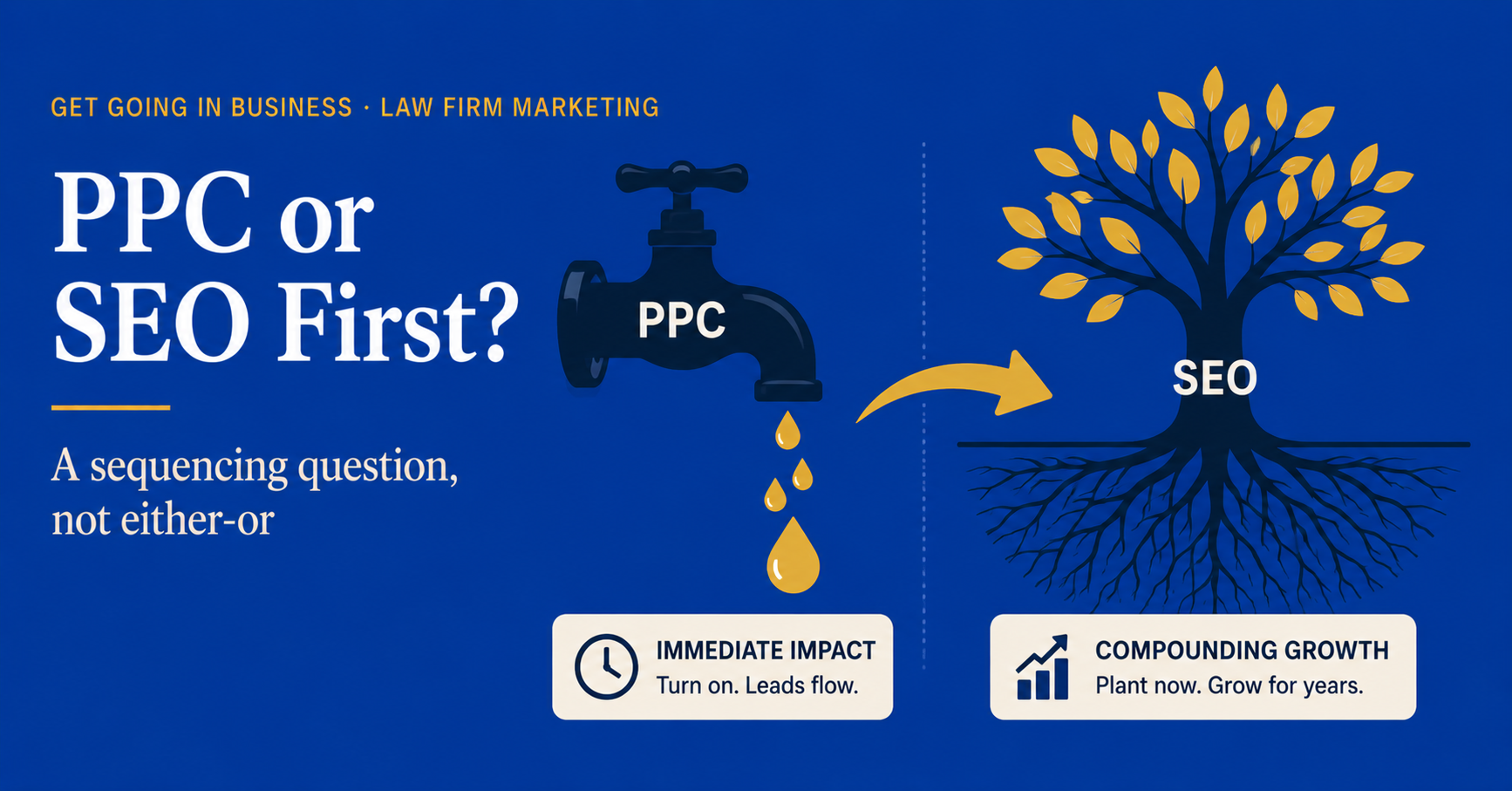
PPC is a lead faucet you can open and close. Useful for immediate volume, dangerous as a long-term strategy because every dollar produces one dollar’s worth of leads with no compounding.


SEO (organic search)

You build content, optimize your site, earn backlinks, and over time your pages rank organically in Google. Leads arrive 6 to 18 months after the work begins. Cost per lead drops dramatically as rankings stabilize. The day you stop investing, rankings hold for months.


SEO is a flywheel. The first turn is the hardest. Once it is spinning, leads keep coming with relatively little ongoing input.


The trade-off in one sentence

PPC is faster and more expensive. SEO is slower and cheaper. PPC stops when you stop paying. SEO compounds. Neither one is universally better. The sequencing depends on your situation.


The Three Situations and What to Lead With


Situation 1: You need clients now

New firm, slow quarter, partner just left, opened a new office, or pipeline is empty. You need lead flow this month, not next year.

Lead with PPC. Allocate 70 to 80 percent of marketing budget to paid acquisition for the first 90 to 120 days. Build SEO in the background, but recognize it will not pay off in this window. The job right now is to fill the pipeline. Paid ads are the only marketing channel that responds in days, not months.


Situation 2: You have steady volume but cost per signed client is too high

PPC is working, you are paying for it, and the unit economics are getting tight. You need to lower cost per signed client without losing volume.


Now is when SEO matters. Invest in content and organic search for the next 12 months. Over that period, organic leads will start to supplement (and eventually partially replace) paid leads. Your overall cost per signed client will drop as organic share grows. PPC stays running but you stop trying to scale it up.


This is the most common situation for firms in years 3 to 7. Pipeline is fine, margins are getting squeezed, time to invest in compounding channels.


Situation 3: You have established rankings and predictable lead flow

Mature firm, strong organic presence, low cost per signed client, and you want to scale.

Now you can scale PPC aggressively. Your unit economics are strong because the SEO base is contributing. Adding paid spend on top of an SEO-fed pipeline is the most profitable marketing posture a law firm can be in. Most firms never reach this stage because they treated PPC and SEO as competing budgets instead of sequenced ones.


How Intake Quality Decides the Math

Most discussions of law firm PPC vs SEO which is better skip the most important variable: your intake conversion rate.


If your intake converts at 30 percent or above

Aggressive paid spend works. Even at $400 per lead, if 30 percent of those leads sign retainers, your cost per signed client is $1,333. If your average case value is $5,000+, that math is fine. Pour fuel on PPC. Build SEO in parallel for the long game.


If your intake converts at 15 to 30 percent

You are in the squeeze zone. Paid leads are expensive enough that intake leakage really hurts. Before scaling either channel, fix intake. Adding more leads to a leaky funnel is the most common waste in law firm marketing. We covered the structural fix in our guide on law firm intake and marketing alignment.


If your intake converts below 15 percent

Spending more on either PPC or SEO is the wrong move. Both channels will deliver leads. Your firm will lose most of them. Pause the spend question. Fix the intake first. Most firms that read this and look at their actual numbers discover that their intake conversion is the bottleneck, not their marketing channel choice.


Intake conversion rate is the multiplier on every marketing dollar. A firm with 30 percent intake conversion gets twice as many cases from the same spend as a firm with 15 percent. Channel choice matters less than the multiplier.


Common Mistakes in Choosing Between Them

Mistake 1: Treating them as either-or

PPC and SEO are not competitors. They are complementary investments on different timelines. The wrong question is “which should we choose.” The right question is “which should we lead with, and when do we layer the other one in.”


Mistake 2: Trying to do both at half-strength

A firm with a $4,000 monthly marketing budget cannot fund both a serious PPC campaign and a serious SEO program. The math does not work. Pick one, fund it properly, layer in the second only when the first is producing.


Mistake 3: Switching back and forth based on the last quarter

Firms that pause SEO when PPC slows, then pause PPC to invest in SEO, then panic and restart PPC, never give either channel time to work. Pick a sequence. Commit to it for at least 12 months. Review at the year mark.


Mistake 4: Underspending on SEO

SEO at $500 a month is not SEO. It is a content writer with a part-time schedule. Serious SEO for a competitive law firm market is $3,000 to $8,000 a month minimum. If you cannot fund that, lead with PPC until you can. Half-invested SEO produces half-invested results, which is worse than no investment because it eats budget without compounding.


The Practical Sequencing Framework


Year 1: PPC primary, SEO foundation

Allocate 70 percent of marketing budget to PPC. Use the remaining 30 percent to build the SEO foundation: a properly optimized website, local SEO setup, technical fundamentals, the first 12 to 18 cornerstone pieces of content. SEO will not produce leads in year 1. That is fine. The job in year 1 is foundation.


Year 2: 60/40 PPC to SEO, SEO starts producing

Shift slightly. PPC at 60 percent, SEO at 40 percent. Around month 8 to 12, your SEO foundation starts producing organic leads. Cost per signed client begins to drop as the channel mix improves.


Year 3: 50/50 balance, both channels mature

Most firms reach genuine balance in year 3. PPC scales as the firm grows. SEO compounds as content ages and authority builds. Cost per signed client typically lands 30 to 50 percent lower than year 1.


Year 4 and beyond: SEO dominant, PPC tactical

Established firms with strong organic presence often shift to 40 percent PPC, 60 percent SEO. PPC becomes a tactical lever for capacity adjustments and new practice area launches rather than the primary lead source. SEO becomes the steady base that pays the bills.


Frequently Asked Questions


Can I do PPC and SEO at the same time from day one?

Yes, if the budget supports both at full strength. The rule of thumb is total marketing spend of at least $10,000 a month before you can fund both channels seriously. Below that, lead with one, layer in the other later.


How long does it take SEO to produce leads for a law firm?

In competitive markets, 9 to 18 months for meaningful organic lead flow. In less competitive geographies or niche practice areas, 4 to 9 months. The single biggest variable is content velocity and authority-building. Slow content = slow rankings.


Is local SEO different from regular SEO for law firms?

Yes. Local SEO focuses on Google Business Profile optimization, local citations, review velocity, and location-specific content. Most law firms benefit more from local SEO than from broad national SEO, especially in family law, criminal defense, and personal injury.


Should I trust an agency that tells me to do both?

Sometimes yes, sometimes no. Ask them specifically: “What budget should we put into each, and what does success look like at month 6 in both channels?” If the answer is specific, they probably know what they are doing. If the answer is vague, they want to sell you both because the retainer is bigger.


Get Help Sequencing Your Marketing

If you read this and realized you have been doing both channels at half-strength, or running them as if they were competing, the fix is sequencing. We can review your current spend, your intake conversion rate, and your growth stage, and give you a clear 12-month plan for which channel leads and when the other one layers in.


Want help deciding whether to lead with PPC or SEO at your firm?


Book your free 15-min strategy call at getgoinginbusiness.com


Related: How Much Should a Law Firm Spend on Marketing? A Realistic Breakdown


PPC for Law Firms: How to Know If Your Agency Is Actually Performing

how to know if PPC is working law firm, 4 agency failure signs vs 3 intake problems


Every month, a managing partner somewhere opens an email from their PPC agency. The report is full of impressions, click-through rates, cost per click trends, and quality score improvements. The agency is upbeat. The numbers are mostly green.


The partner closes the email and thinks the same thing they thought last month: the agency says PPC is working, but the firm is not signing more clients. Are we being told the truth?


This is the most common conversation in law firm marketing. The question of how to know if PPC is working law firm owners ask every quarter, and most never get a real answer. The reports look fine. The signed cases do not match.


Here is the honest framework. Four signs your agency is failing, three signs your agency is fine but something else is broken, and a clear test to tell them apart.


Why You Cannot Trust the Standard PPC Report

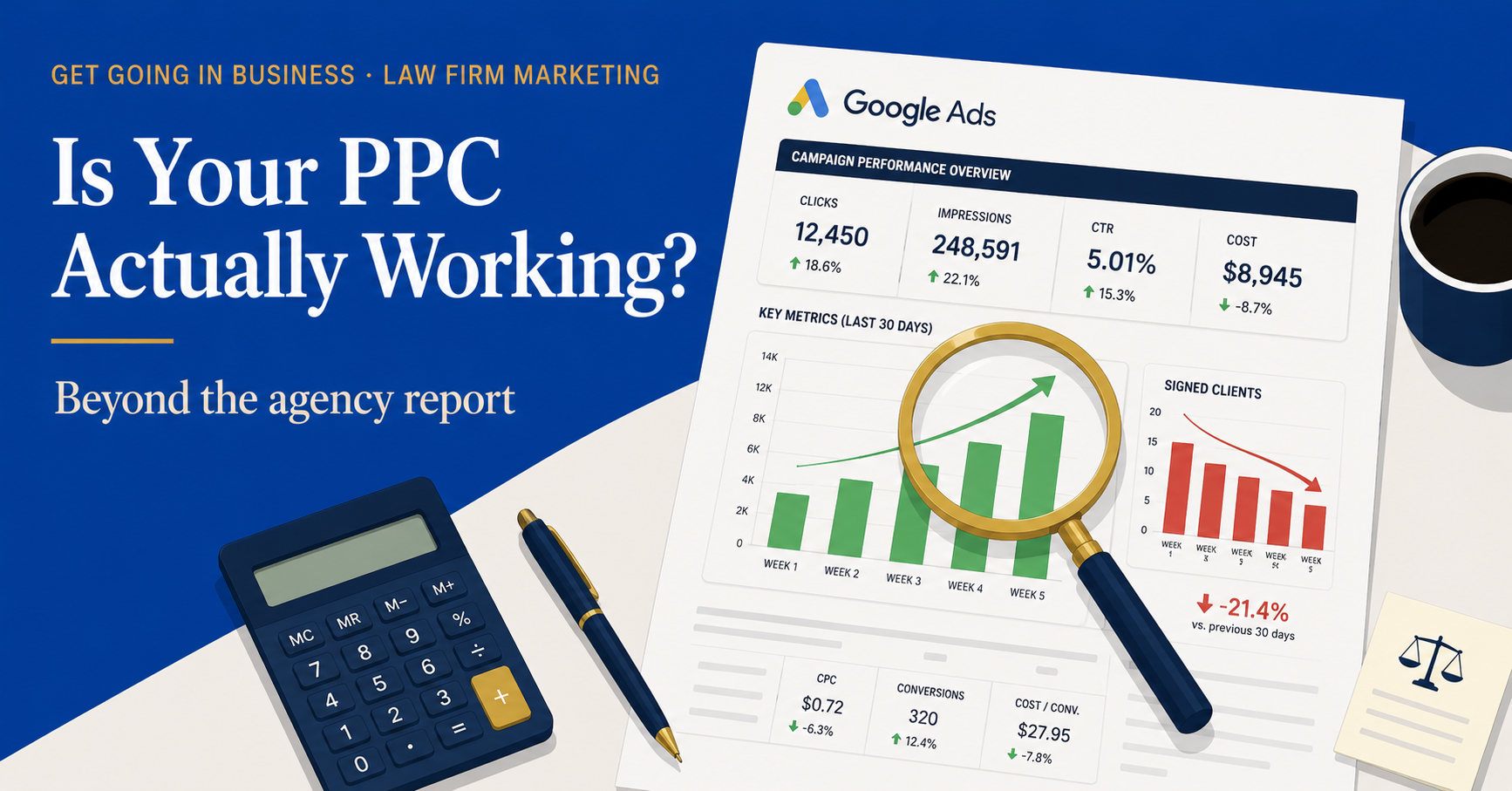
A typical agency report shows: impressions, clicks, click-through rate, cost per click, conversions, and conversion rate. All of these are real metrics. None of them tell you whether PPC is producing signed clients for your firm.


The reason is simple. A conversion in Google Ads usually means “someone filled out a form” or “someone clicked a phone number.” It does not mean “someone called, the call was answered, they booked a consultation, and they signed a retainer.” Between Google’s definition of a conversion and your firm’s definition of a signed client, anywhere from 60 to 95 percent of the value drops out.


Agencies report on what Google reports. Google reports on what happens on the ad platform. Neither one has visibility into your CRM, your intake calls, or your retainer agreements. The result is reports that show PPC “working” while your bank account disagrees.


4 Real Signs Your PPC Agency Is Failing

These are the agency-side problems. If any of these are true, the issue is the agency itself, not your intake or your offer.


Sign 1: They cannot tell you cost per signed client

Ask your agency: “What is our cost per signed retainer from PPC over the last 90 days?” If they cannot answer in five minutes, they are not tracking the metric that matters. Cost per click is interesting. Cost per signed client is the only number that proves whether PPC is profitable for your firm.


A good agency has an answer ready. A failing agency will deflect to “that depends on your CRM” or “we measure conversions, not signed retainers.” Both are excuses. The agency should be integrated with your CRM. If they are not, that is their failure, not yours.


Sign 2: They are bidding on the wrong intent keywords

Pull your search terms report (or have them pull it). Look at the actual queries that triggered your ads in the last 30 days. You are looking for two things:

  • Information-seeking queries (“what is the statute of limitations,” “do I need a lawyer for a fender bender”) that are spending budget but rarely produce signed cases
  • Competitor brand queries that look like wins but actually have terrible signed-client rates

A good agency aggressively filters these out with negative keywords. A failing agency lets them keep spending because the conversion volume looks good on the report.


Sign 3: The landing pages are generic

Click your own PPC ad right now. Where does it go? If it goes to your homepage, your agency is failing. If it goes to a generic “contact us” page, your agency is failing. If it goes to a landing page that mentions the specific service you advertised, with a phone number above the fold and a simple form, the agency is doing this part right.

Generic landing pages waste 30 to 50 percent of qualified clicks. There is no excuse for them in 2026.


Sign 4: They will not give you transparent access to the Google Ads account

You should have full Google Ads access. Not a screenshot. Not a PDF report. Actual login access to your own account. If your agency refuses or makes this difficult, the account is not yours, the agency owns your spend, and you are locked in.


This one is non-negotiable. A good agency hands you the keys on day one and trusts you to use them. A failing agency gatekeeps the account because they know what is inside it would not survive transparency.

If three of these four signs are true at your firm, the agency is the problem. If only one is true, the issue is probably elsewhere in your funnel.


3 Signs the Agency Is Fine but Intake Is the Problem

These are the patterns we see at firms where the PPC agency is actually doing solid work, but signed clients are still not showing up. The breakdown is happening inside the firm.


Sign 1: Leads are coming in but no one is answering fast enough

Pull the timestamps on the last 50 PPC leads. Compare them to the timestamps of your first contact attempt. If more than 25 percent of leads are not contacted within 15 minutes, the agency is doing its job and your intake is killing the leads.

Speed-to-lead is the single biggest predictor of consultation booking rate. A 15-minute response converts at roughly 3x the rate of a 60-minute response. Your agency cannot fix this. Only your intake team can.


Sign 2: Consultations are booked but not closing

If consultation booking rate is healthy (above 35 percent of qualified leads) but signed-retainer rate is low (below 25 percent of consultations), the agency is delivering qualified leads and your closing process is the bottleneck. This is an attorney training issue or a pricing issue, not a marketing issue.


Sign 3: The cost per signed client is fine, you just want more volume

Sometimes the agency is doing well, the math works, and the firm simply has not increased budget enough to scale. If your cost per signed client is profitable and your case capacity is not maxed, the answer is more spend, not a different agency.

Firms often fire their PPC agency right when they should be doubling their budget. Check the unit economics before you make a change.


The 5-Minute Test

Here is a fast diagnostic you can run today. Pull these five numbers for the last 90 days:

  • Total PPC spend
  • Total qualified leads from PPC
  • Total consultations from those leads
  • Total signed retainers from those consultations
  • Average case value

Now do the math:

  • Cost per lead = Total spend ÷ Total leads
  • Lead to consultation rate = Consultations ÷ Leads
  • Consultation to signed rate = Signed ÷ Consultations
  • Cost per signed client = Total spend ÷ Total signed
  • Marketing ROI = (Signed × Case Value) ÷ Total Spend

Three possible outcomes:


Outcome A: Cost per signed client is profitable

If cost per signed client is less than 30 percent of average case value, your PPC is working. The agency may not be perfect, but the unit economics are. Optimize, do not replace.


Outcome B: Cost per lead is high, intake metrics are good

If your cost per lead is high but your intake conversion rates are healthy, your agency is the problem. They are delivering expensive leads that your team is converting well. A better agency would deliver cheaper leads at the same conversion rate.


Outcome C: Cost per lead is reasonable, intake metrics are weak

If leads are coming in at a reasonable cost but lead-to-consultation or consultation-to-signed rates are below benchmark, your agency is doing its job. The breakdown is inside your firm. Fixing intake or closing will produce more gains than switching agencies.


The Conversation to Have With Your Agency

Once you have the numbers, schedule a 30-minute call with your agency. Bring the data. Ask three questions:

  • “Our cost per signed client over the last 90 days is X. Is that profitable for our firm given our average case value of Y?”
  • “What specific changes would you make in the next 30 days to lower that number?”
  • “What do you need from us, in terms of CRM data or intake reporting, to optimize against signed clients instead of conversions?”

A good agency will engage with all three questions, push back on any numbers they think are wrong, and give you a concrete plan with timelines. A failing agency will get defensive, blame your intake, and pivot the conversation back to clicks and impressions.

How they respond to those three questions tells you almost everything you need to know.


When to Actually Fire Them

Three conditions, all true at once:

  • Cost per signed client is unprofitable AND has been for at least 90 days
  • You have given them clear feedback and a specific 30-day window to improve
  • They cannot or will not give you transparent CRM-integrated reporting

Firing a PPC agency without those three conditions usually just resets the clock with the next agency. The new agency takes 60 to 90 days to ramp up, makes the same mistakes, and you are 6 months further from profitable PPC.


If you are going to make the change, document the decision in writing, request all account access and data exports, and give 30 days’ notice. Then run a focused search for a new agency that already has law firm experience and CRM integration capability.


Frequently Asked Questions

What is a reasonable cost per signed client from PPC for law firms?

It depends entirely on practice area and case value. Personal injury firms commonly accept $2,000 to $5,000 per signed client because case values are high. Family law firms typically need to stay under $800 to $1,200. Estate planning firms aim for $400 to $700. The metric to watch is the ratio: cost per signed client should be less than 30 percent of average case value.


How long should I give a new PPC agency before judging them?

90 days. The first 30 days are setup and learning. Days 31 to 60 are optimization. Days 61 to 90 should show measurable improvement against cost per signed client. If they have not produced a clear trend by day 90, they will not.


Should I switch from an agency to in-house PPC?

Only if you are spending more than $15,000 a month on ads. Below that, the cost of a qualified in-house PPC manager exceeds what you save on agency fees. Above that, in-house starts to make sense, especially for firms with multiple practice areas.


My agency offered to lower their fee. Should I stay?

A fee cut does not fix bad targeting, generic landing pages, or refusal to integrate with your CRM. If those issues exist, a 20 percent fee reduction does not solve them. If those issues do not exist, you probably do not need to leave anyway. Fee renegotiations are usually a distraction from the real conversation.


Get Help Auditing Your PPC Agency

If you are stuck between “the reports look fine” and “the signed cases do not match,” we can run the 5-minute test on your firm in real numbers and tell you, with specificity, whether the issue is your agency, your intake, or your offer. No pitch. Just a clearer answer than your current monthly report gives you.


Want help figuring out if your PPC agency is actually performing?


Book your free 15-min strategy call at getgoinginbusiness.com


Related: How to Build a Law Firm Marketing Dashboard That Actually Makes Sense

7 Signs Your Law Firm’s PPC Agency Is Failing You (And What to Do About It)

7 Signs Your Law Firm PPC Agency Is Failing You


You’re spending $5,000, $10,000, maybe $15,000 a month on Google Ads. You’re getting leads. But you’re not getting clients — or at least not enough of them to justify the spend. Your agency sends you a report every month. It shows impressions, clicks, and cost per click. But your signed cases aren’t moving.


Before you fire your agency, read this. Four of the seven signs below are genuine agency failures. Three of them look like agency failures but are actually intake problems. Knowing which is which saves you time, money, and a difficult conversation.


Signs That Point to the Agency


Sign 1: No Conversion Tracking Beyond the Form Fill


If your agency’s definition of a conversion is a form submission, they are optimizing for the wrong outcome. A form fill is not a client. An agency that is not tracking call conversions, consultation bookings, and — ideally — retained clients is flying blind and will optimize for lead volume rather than lead quality.


Sign 2: Ads Driving Traffic to Your Homepage


PPC ads should send traffic to dedicated landing pages that match the ad’s message and have one clear call to action. If your ads are sending traffic to your general homepage, your conversion rate will be a fraction of what it should be. This is a basic error that indicates the agency is not approaching your account with proper methodology.


Sign 3: Reports Full of Marketing Metrics, No Business Metrics


If your monthly report shows impressions, click-through rate, cost per click, and quality score — but nothing about cost per consultation, consultation rate, or conversion to retained client — your agency is reporting on their work, not your results. A good agency reports on the numbers that matter to your business.


Sign 4: No Proactive Communication Between Reports


A PPC account needs active management. Bids change. Competition changes. Seasonal patterns shift. If you only hear from your agency when the monthly report arrives — and never proactively about changes in performance or strategy adjustments — your account is likely on autopilot.


Signs That Look Like Agency Failures But Aren’t


Sign 5: Leads Are Coming In But Not Converting


This feels like an agency problem — they’re generating leads that don’t convert, so the leads must be bad. Sometimes that’s true. But often, the leads are fine and the conversion problem is in intake: slow response time, no follow-up sequence, a consultation process that doesn’t close.


Before blaming your law firm PPC agency, check your response time data and your consultation-to-retained rate. If either is weak, fix those first before changing your PPC strategy


Sign 6: Cost Per Lead Is High


High cost per lead is sometimes an agency efficiency problem. But it can also reflect a competitive market, a niche practice area, or a geographic targeting decision that is correct strategically but expensive in practice. Ask your agency to benchmark your CPL against industry averages for your practice area before concluding it is too high.


Sign 7: Call Volume Is Up But Signed Cases Are Flat


Calls are up but clients aren’t. This pattern almost always points to intake, not ads. The agency is delivering volume. Something in your intake process — response time, follow-up, consultation close rate — is not converting that volume into revenue. Increasing your ad budget in this scenario makes the problem more expensive, not better.


What to Do


If you identified genuine agency failures: have a direct conversation. Share your business metrics — not just their marketing metrics. Ask for a specific improvement plan with a 60-day timeline. If nothing changes, find an agency that manages to business outcomes.


If you identified intake failures: don’t touch the agency yet. Fix intake first. Improve your response time, build your follow-up sequence, and review your consultation process. Then reassess the marketing performance once the intake system is working.


The fastest way to improve your marketing ROI is often not to change your marketing. It’s to fix what happens after the lead arrives.


Not sure whether your problem is your agency or your intake process? Let’s find out.

Book your free 15-min strategy call at getgoinginbusiness.com


Related: How to Organize Your Law Firm’s Marketing Vendors & Stop Wasting Money →

Law Firm Leads Not Converting? Here Are 7 Reasons Why (And None of Them Are Your Marketing)

Law Firm Leads Not Converting - 7 Reasons Why


You’re running Google Ads. Your SEO is generating traffic. Leads are coming in. But when you look at your signed cases at the end of the month, the number doesn’t match. You call your marketing agency. They show you the lead data. The leads are there. So where are they going?


Before you cut your marketing budget or fire your agency, read this. In most cases, the problem is not the marketing. It’s what happens after the lead arrives.

Marketing gets credit for leads. Intake gets credit for clients. Most law firms invest heavily in the first and almost nothing in the second — which is exactly why law firm leads not converting is the silent killer of growth


Reason 1: Your Response Time Is Too Slow


This is the most common and most costly reason leads do not convert. The data is unambiguous: the faster you respond to a new inquiry, the higher your conversion rate. Firms that respond within five minutes are dramatically more likely to reach the lead than those that wait even 30 minutes.


Why? Because when someone has a legal problem, they are usually contacting multiple firms simultaneously. The first firm that responds professionally and books the consultation typically gets the client. If you respond six hours later, they have already moved on.


Reason 2: Nobody Followed Up After the First Attempt


Most leads require more than one contact attempt before they respond. Voicemails go unreturned. Emails get missed. People get busy. If your intake process stops at one attempt, you are leaving a significant portion of your pipeline unconverted — not because the leads weren’t interested, but because nobody tried twice.


Reason 3: The Lead Had No Idea What to Do Next


After a lead submits a form or calls your office, what happens? If the answer is ‘they wait for someone to call them back,’ you have a conversion gap. High-converting firms send an immediate acknowledgement that tells the lead exactly what to expect and when. This keeps the lead engaged and prevents them from calling the next firm on their list while they wait.


Reason 4: Booking a Consultation Was Too Complicated


If booking a consultation requires a phone call during business hours, followed by an email to confirm, followed by a calendar invite — some leads will not complete that process. Every additional step between ‘interested’ and ‘booked’ reduces your conversion rate. The firms that make it effortless — one click to a scheduling page, instant confirmation, automated reminder — convert more leads from the same traffic.


Reason 5: The Consultation Ended Without a Clear Next Step


A consultation where the potential client leaves without a clear understanding of what happens next is a consultation that often does not convert. They go home, think about it, get busy, and never call back. Firms that end every consultation with a specific next step — ‘I will send you the engagement agreement by end of day, please review and sign by Thursday’ — convert at a significantly higher rate.


Reason 6: Your Intake Team and Marketing Team Are Not Sharing Information


Your marketing agency is optimizing for lead volume. Your intake team is working the leads. But are they talking to each other? Does your agency know which lead sources are producing clients — not just leads? Does your intake team know what messaging the ads are using so they can match expectations on the call?


When these two functions operate in silos, you end up with marketing that drives high volume but low quality leads, and an intake team that is frustrated by leads that never convert. The fix is shared data and regular communication between both sides.


Reason 7: You Have No Visibility Into Where Leads Are Dropping Off


If you cannot see your lead-to-consultation rate, your consultation-to-retained rate, and your response time average — you cannot identify where your conversion problem actually lives. You are guessing. And guessing leads to the wrong fixes.


Before you change your marketing strategy, build the reporting to understand your conversion funnel. The problem might be response time. It might be consultation close rate. It might be follow-up. You cannot know without the data.


Where to Start


If any of these reasons resonated, start with the one that you know is true right now. Don’t try to fix all seven at once. Fix the biggest leak first.


  • If response time is the issue — implement an automated acknowledgement and a five-minute follow-up target
  • If follow-up is the issue — document a three-attempt sequence and put it in your CRM
  • If booking is the issue — add a scheduling link to your website and intake emails
  • If reporting is the issue — configure your CRM to track lead source, status, and conversion rates


The leads are there. The marketing is working. The question is whether your intake process is built to capture what your marketing is generating.


Not sure where your leads are dropping off? Let’s find out together.

Book your free 15-min strategy call at getgoinginbusiness.com


Related: How to Organize Your Law Firm’s Marketing Vendors & Stop Wasting Money →