This question gets asked at every law firm marketing meeting and answered badly almost every time. The PPC vendor says PPC. The SEO vendor says SEO. The agency that does both says “a balanced approach.” None of them are wrong exactly. None of them are answering the question you actually need answered.
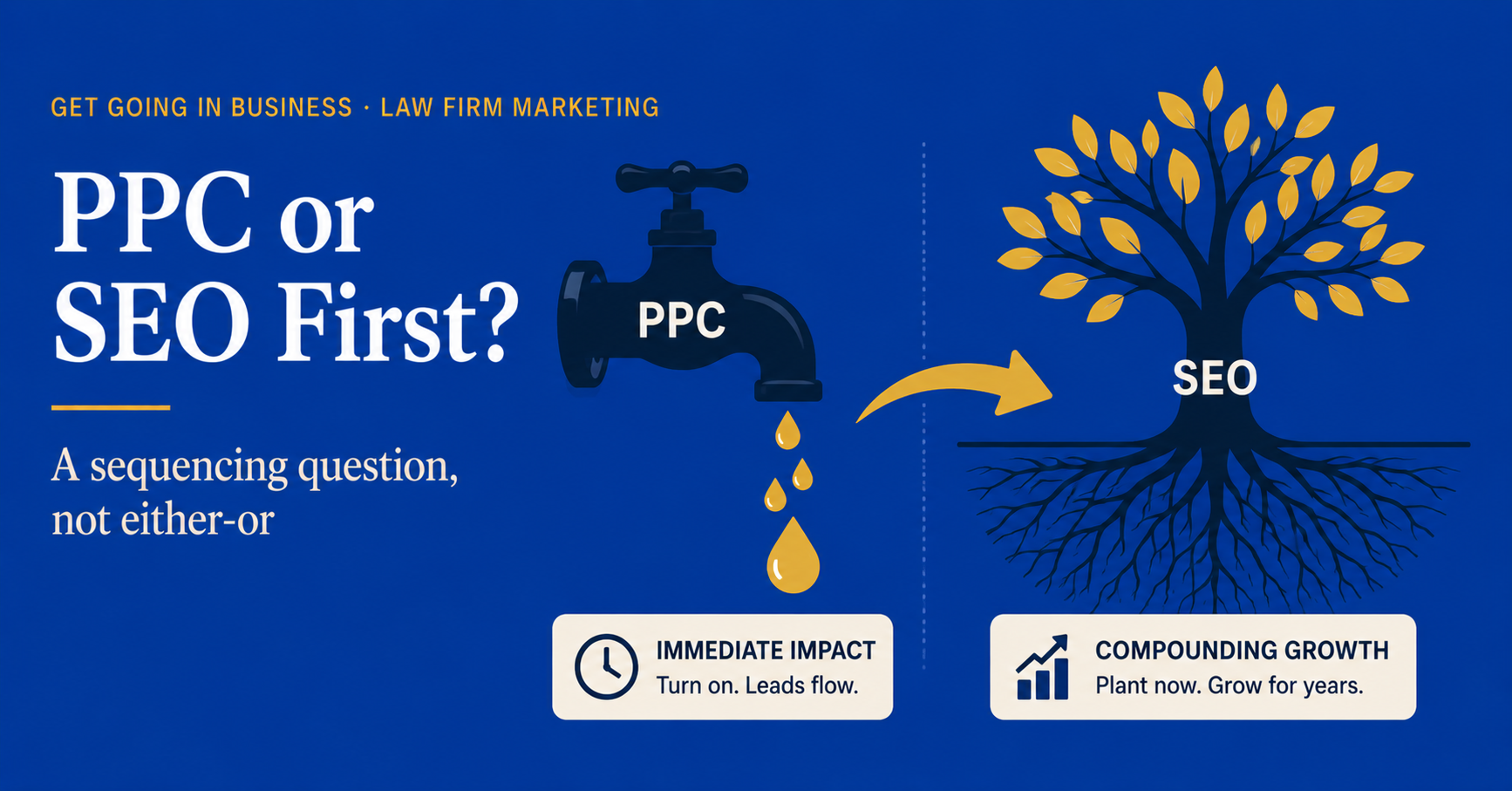
Law firm PPC vs SEO which is better is not a permanent answer. It is a sequencing question. The right answer changes depending on where your firm is right now, what your intake can handle, and how much patience you have for results that compound over time instead of arriving next Tuesday.
This guide breaks down when to lead with each, when to do both, and how intake quality should make the call.
What Each One Actually Does
Before sequencing, understand the difference. PPC and SEO are often grouped under “digital marketing” but they solve different problems on different timelines.
PPC (paid search)
You bid on keywords, your ads show at the top of Google results, you pay per click. Leads arrive within hours of campaign launch. Cost per lead is high but predictable. The day you turn it off, leads stop.
PPC is a lead faucet you can open and close. Useful for immediate volume, dangerous as a long-term strategy because every dollar produces one dollar’s worth of leads with no compounding.
SEO (organic search)
You build content, optimize your site, earn backlinks, and over time your pages rank organically in Google. Leads arrive 6 to 18 months after the work begins. Cost per lead drops dramatically as rankings stabilize. The day you stop investing, rankings hold for months.
SEO is a flywheel. The first turn is the hardest. Once it is spinning, leads keep coming with relatively little ongoing input.
The trade-off in one sentence
PPC is faster and more expensive. SEO is slower and cheaper. PPC stops when you stop paying. SEO compounds. Neither one is universally better. The sequencing depends on your situation.
The Three Situations and What to Lead With
Situation 1: You need clients now
New firm, slow quarter, partner just left, opened a new office, or pipeline is empty. You need lead flow this month, not next year.
Lead with PPC. Allocate 70 to 80 percent of marketing budget to paid acquisition for the first 90 to 120 days. Build SEO in the background, but recognize it will not pay off in this window. The job right now is to fill the pipeline. Paid ads are the only marketing channel that responds in days, not months.
Situation 2: You have steady volume but cost per signed client is too high
PPC is working, you are paying for it, and the unit economics are getting tight. You need to lower cost per signed client without losing volume.
Now is when SEO matters. Invest in content and organic search for the next 12 months. Over that period, organic leads will start to supplement (and eventually partially replace) paid leads. Your overall cost per signed client will drop as organic share grows. PPC stays running but you stop trying to scale it up.
This is the most common situation for firms in years 3 to 7. Pipeline is fine, margins are getting squeezed, time to invest in compounding channels.
Situation 3: You have established rankings and predictable lead flow
Mature firm, strong organic presence, low cost per signed client, and you want to scale.
Now you can scale PPC aggressively. Your unit economics are strong because the SEO base is contributing. Adding paid spend on top of an SEO-fed pipeline is the most profitable marketing posture a law firm can be in. Most firms never reach this stage because they treated PPC and SEO as competing budgets instead of sequenced ones.
How Intake Quality Decides the Math
Most discussions of law firm PPC vs SEO which is better skip the most important variable: your intake conversion rate.
If your intake converts at 30 percent or above
Aggressive paid spend works. Even at $400 per lead, if 30 percent of those leads sign retainers, your cost per signed client is $1,333. If your average case value is $5,000+, that math is fine. Pour fuel on PPC. Build SEO in parallel for the long game.
If your intake converts at 15 to 30 percent
You are in the squeeze zone. Paid leads are expensive enough that intake leakage really hurts. Before scaling either channel, fix intake. Adding more leads to a leaky funnel is the most common waste in law firm marketing. We covered the structural fix in our guide on law firm intake and marketing alignment.
If your intake converts below 15 percent
Spending more on either PPC or SEO is the wrong move. Both channels will deliver leads. Your firm will lose most of them. Pause the spend question. Fix the intake first. Most firms that read this and look at their actual numbers discover that their intake conversion is the bottleneck, not their marketing channel choice.
Intake conversion rate is the multiplier on every marketing dollar. A firm with 30 percent intake conversion gets twice as many cases from the same spend as a firm with 15 percent. Channel choice matters less than the multiplier.
Common Mistakes in Choosing Between Them
Mistake 1: Treating them as either-or
PPC and SEO are not competitors. They are complementary investments on different timelines. The wrong question is “which should we choose.” The right question is “which should we lead with, and when do we layer the other one in.”
Mistake 2: Trying to do both at half-strength
A firm with a $4,000 monthly marketing budget cannot fund both a serious PPC campaign and a serious SEO program. The math does not work. Pick one, fund it properly, layer in the second only when the first is producing.
Mistake 3: Switching back and forth based on the last quarter
Firms that pause SEO when PPC slows, then pause PPC to invest in SEO, then panic and restart PPC, never give either channel time to work. Pick a sequence. Commit to it for at least 12 months. Review at the year mark.
Mistake 4: Underspending on SEO
SEO at $500 a month is not SEO. It is a content writer with a part-time schedule. Serious SEO for a competitive law firm market is $3,000 to $8,000 a month minimum. If you cannot fund that, lead with PPC until you can. Half-invested SEO produces half-invested results, which is worse than no investment because it eats budget without compounding.
The Practical Sequencing Framework
Year 1: PPC primary, SEO foundation
Allocate 70 percent of marketing budget to PPC. Use the remaining 30 percent to build the SEO foundation: a properly optimized website, local SEO setup, technical fundamentals, the first 12 to 18 cornerstone pieces of content. SEO will not produce leads in year 1. That is fine. The job in year 1 is foundation.
Year 2: 60/40 PPC to SEO, SEO starts producing
Shift slightly. PPC at 60 percent, SEO at 40 percent. Around month 8 to 12, your SEO foundation starts producing organic leads. Cost per signed client begins to drop as the channel mix improves.
Year 3: 50/50 balance, both channels mature
Most firms reach genuine balance in year 3. PPC scales as the firm grows. SEO compounds as content ages and authority builds. Cost per signed client typically lands 30 to 50 percent lower than year 1.
Year 4 and beyond: SEO dominant, PPC tactical
Established firms with strong organic presence often shift to 40 percent PPC, 60 percent SEO. PPC becomes a tactical lever for capacity adjustments and new practice area launches rather than the primary lead source. SEO becomes the steady base that pays the bills.
Frequently Asked Questions
Can I do PPC and SEO at the same time from day one?
Yes, if the budget supports both at full strength. The rule of thumb is total marketing spend of at least $10,000 a month before you can fund both channels seriously. Below that, lead with one, layer in the other later.
How long does it take SEO to produce leads for a law firm?
In competitive markets, 9 to 18 months for meaningful organic lead flow. In less competitive geographies or niche practice areas, 4 to 9 months. The single biggest variable is content velocity and authority-building. Slow content = slow rankings.
Is local SEO different from regular SEO for law firms?
Yes. Local SEO focuses on Google Business Profile optimization, local citations, review velocity, and location-specific content. Most law firms benefit more from local SEO than from broad national SEO, especially in family law, criminal defense, and personal injury.
Should I trust an agency that tells me to do both?
Sometimes yes, sometimes no. Ask them specifically: “What budget should we put into each, and what does success look like at month 6 in both channels?” If the answer is specific, they probably know what they are doing. If the answer is vague, they want to sell you both because the retainer is bigger.
Get Help Sequencing Your Marketing
If you read this and realized you have been doing both channels at half-strength, or running them as if they were competing, the fix is sequencing. We can review your current spend, your intake conversion rate, and your growth stage, and give you a clear 12-month plan for which channel leads and when the other one layers in.
Want help deciding whether to lead with PPC or SEO at your firm?
Book your free 15-min strategy call at getgoinginbusiness.com
Related: How Much Should a Law Firm Spend on Marketing? A Realistic Breakdown →