You’re running Google Ads. Your SEO is generating traffic. Leads are coming in. But when you look at your signed cases at the end of the month, the number doesn’t match. You call your marketing agency. They show you the lead data. The leads are there. So where are they going?
Before you cut your marketing budget or fire your agency, read this. In most cases, the problem is not the marketing. It’s what happens after the lead arrives.
Marketing gets credit for leads. Intake gets credit for clients. Most law firms invest heavily in the first and almost nothing in the second — which is exactly why law firm leads not convertingis the silent killer of growth
Reason 1: Your Response Time Is Too Slow
This is the most common and most costly reason leads do not convert. The data is unambiguous: the faster you respond to a new inquiry, the higher your conversion rate. Firms that respond within five minutes are dramatically more likely to reach the lead than those that wait even 30 minutes.
Why? Because when someone has a legal problem, they are usually contacting multiple firms simultaneously. The first firm that responds professionally and books the consultation typically gets the client. If you respond six hours later, they have already moved on.
Reason 2: Nobody Followed Up After the First Attempt
Most leads require more than one contact attempt before they respond. Voicemails go unreturned. Emails get missed. People get busy. If your intake process stops at one attempt, you are leaving a significant portion of your pipeline unconverted — not because the leads weren’t interested, but because nobody tried twice.
Reason 3: The Lead Had No Idea What to Do Next
After a lead submits a form or calls your office, what happens? If the answer is ‘they wait for someone to call them back,’ you have a conversion gap. High-converting firms send an immediate acknowledgement that tells the lead exactly what to expect and when. This keeps the lead engaged and prevents them from calling the next firm on their list while they wait.
Reason 4: Booking a Consultation Was Too Complicated
If booking a consultation requires a phone call during business hours, followed by an email to confirm, followed by a calendar invite — some leads will not complete that process. Every additional step between ‘interested’ and ‘booked’ reduces your conversion rate. The firms that make it effortless — one click to a scheduling page, instant confirmation, automated reminder — convert more leads from the same traffic.
Reason 5: The Consultation Ended Without a Clear Next Step
A consultation where the potential client leaves without a clear understanding of what happens next is a consultation that often does not convert. They go home, think about it, get busy, and never call back. Firms that end every consultation with a specific next step — ‘I will send you the engagement agreement by end of day, please review and sign by Thursday’ — convert at a significantly higher rate.
Reason 6: Your Intake Team and Marketing Team Are Not Sharing Information
Your marketing agency is optimizing for lead volume. Your intake team is working the leads. But are they talking to each other? Does your agency know which lead sources are producing clients — not just leads? Does your intake team know what messaging the ads are using so they can match expectations on the call?
When these two functions operate in silos, you end up with marketing that drives high volume but low quality leads, and an intake team that is frustrated by leads that never convert. The fix is shared data and regular communication between both sides.
Reason 7: You Have No Visibility Into Where Leads Are Dropping Off
If you cannot see your lead-to-consultation rate, your consultation-to-retained rate, and your response time average — you cannot identify where your conversion problem actually lives. You are guessing. And guessing leads to the wrong fixes.
Before you change your marketing strategy, build the reporting to understand your conversion funnel. The problem might be response time. It might be consultation close rate. It might be follow-up. You cannot know without the data.
Where to Start
If any of these reasons resonated, start with the one that you know is true right now. Don’t try to fix all seven at once. Fix the biggest leak first.
If response time is the issue — implement an automated acknowledgement and a five-minute follow-up target
If follow-up is the issue — document a three-attempt sequence and put it in your CRM
If booking is the issue — add a scheduling link to your website and intake emails
If reporting is the issue — configure your CRM to track lead source, status, and conversion rates
The leads are there. The marketing is working. The question is whether your intake process is built to capture what your marketing is generating.
Not sure where your leads are dropping off? Let’s find out together.
Increasing inbound leads is so easy, right? Make content, talk on podcasts, present webinars, eventually have a high ranking on SERPs, and finally, acquire leads. Ka-Ching!
Nevertheless, the lead generation tactics that are successful for some may not have the same effect for you. It can be even more discouraging to invest your time and money into plans and approaches that do not entice your customers.
In this article, we are going to give you a head start in generating leads through inbound marketing. Discovering the distinction between inbound and outbound lead generation and how to amplify inbound leads with successful, tried-and-true techniques that are effective in the modern world is something you can learn.
Comparing Outbound and Inbound Lead Generation
Generating inbound leads involves using strategies such as content marketing, SEO, and social media to draw potential customers into the sales funnel.
Outbound lead generation is more aggressive, as it is designed to thrust sales/marketing communications in front of prospective buyers.
Methods of outbound sales and lead collection consist of:
Participating in industry events
Using cold emails or calls to connect to prospects
Using social media for sales.
Here at GetGoing in Business, we discover and contact prospects who have yet to be incorporated into your sales process.
The marketing group creates webinars, articles, and guest posts which have the effect of generating more inbound leads over a prolonged period of time.
Strategies for Increasing B2B Inbound Leads in 2023
Producing attractive content, making videos with finesse, and perfecting search engine optimization require a lot of work. If your aim is to grow the number of inbound leads, and you have an in-house team, results from producing content will take some time.
It is possible to employ an external source in order to speed up the process. However, if resources are devoted to an unsuccessful inbound lead generation plan, it can lead to a costly expenditure with no measurable outcomes.
Significant capital is necessary for the beginning, making it essential to select the appropriatetactics and techniques from the onset.
Listed below are the verified techniques for augmenting inbound leads and constantly stuffing your sales funnel.
1. Use Podcasts to Attract a Younger Audience
Whether doing housework, commuting to the office, or taking a stroll for pleasure, podcasts have become an integral part of our everyday routine. The 25-34 age group accounts for almost a third of podcast listeners, making podcasts a great tool for connecting to the younger demographic of customers.
For instance, in order to learn from successful business leaders, Michael Sacca created Rocketship.fm to conduct interviews. Because he was occupied with his work in marketing, his goal was to produce three months’ worth of episodes which he could later compile into a book. Nevertheless, the podcast resonated with people and Rocketship.fm quickly picked up momentum. This podcast, created as a side project, has grown to be a vibrant platform for product managers and tech entrepreneurs that earns more than $10k/month!
Having limited resources doesn’t mean that starting a podcast has to be the only way to generate more inbound leads. Making your brand known through other podcasts, either by sponsoring them or taking part in interviews, is just as effective.
From 2013 to 2019, there has been an upward trend in the number of people listening to podcasts. According to Podcast Insights, the percentage of the population tuning in to podcasts has grown year over year.
Podcasts offer variety when it comes to audience reach. Whether you’re looking to explore thehistory of gnomes ortrue crime case reports, there’s a podcast out there for you. This provides access to a diverse range of potential customers in a variety of niches.
It is evident that podcast listeners are a valuable demographic. A large portion of them, 80 percent, are attentive to the entirety of each episode, demonstrating that those individuals are serious about the topics and likely to be interested in making a purchase.
2. Use Youtube to Broaden the Scope of Your Inbound Marketing Efforts
YouTube is one of the most widely used search engines on the web. Yes, even if you’re not in an industry with an abundance of topics to choose from, you can still use it to increase the number of leads you receive.
Ahrefs, for example, is a keyword research tool that has achieved high rankings on YouTube for ultra-competitive search terms such as “SEO tips” and “local SEO”. When using inbound lead generation, content is a very important factor that cannot be overlooked. You don’t have to apply top-notch production values for each and every video, however.
Apart from how-to videos, you can also post:
Expert interviews of people in the same field.
Group-setting conversations.
Customer experiences.
Videos that provide a quick explanation.
Demos and reviews about products.
This is fantastic news because by using the SEO strategies ofYouTube, one can transform their blog posts, checklists, and Q&As into amazing content that draws in prospects.
3. Increase B2B Blog Traffic with Finely-Tuned Content
Following two years of hard work in content creation, ClearVoice’s website traffic and lead production stagnated for six months. No matter what attempts were made to bring back dwindling traffic, there was little to no success.
Despite having a lot of successful whitepapers, ebooks, and other resources that should have increased the number of inbound leads, the organic traffic still did not exceed the 3k/month mark.
Generating exclusive B2B blog articles resulted in a substantial shift from 2,900 to 51,500 lasting monthly pageviews in terms of organic traffic. B2B blogging saved the company from its impending doom as a startup.
Research indicates that the vast majority of blog posts do not get any backlinks or even a slight amount of visitors. Competition in the realm of content marketing is fierce, and more companies fail than succeed. Those companies that succeed share a commonality: the customer is always at the forefront of their content, ensuring that it is valuable.
By taking a look at the B2B organizations that are excelling with their content, you will observe that they all have a distinct viewpoint that is beneficial to their customers.
DataBox is particularly adept at conducting in-depth interviews for intensive articles.
ClearVoice uses polls and facts to produce unique research for its freelancers.
Companies who use Software-as-a-Service (SaaS) products can find comprehensive reviews fromG2, an organization dedicated to providing thorough expert opinions.
For those who are eager to boost their incoming leads, forget about the generic listicles and how-to guides. These forms of content are everywhere and are not very successful in attracting leads. Develop a content plan that is based on creating content that your customers will find valuable.
4. Strengthen Off-Page SEO through Guest Blogging
Leo Widrich, the co-founder of the Buffer app, was able to catapult the SaaS company from an unknown startup to a $5 million business thanks to guest blogging. During a period of 9 months, Leo single-handedly wrote and published an impressive 150 guest posts. This required a lot of dedication and hard work.
Was the effort worth it?
Without a doubt.
The significant amount of time spent penning content for other platforms provided the catalyst for Buffer to become noticed, leading to the acquisition of its first 100,000 users.
Do people still practice guest blogging as a way to boost inbound traffic and leads, or is it a thing of the past? If you’re expecting to generate a ton of traffic to your website… forget about it.
Gone are the days of guest posting.
But generating backlinks to boost your SEO can still be beneficial in terms of garnering inbound leads. A study conducted by SEMrush indicates that guest posting is the most favored link-building approach among SEO professionals, despite its fluctuating history.
Backlinks and SEO can be improved through guest posting, even though it is not a major contributor to referral traffic any longer.
Pros in the inbound marketing field such as Hubspot, Ahrefs, and Neil Patel continue to utilize guest blogging as means to generate inbound leads. This strategy has been employed by these professionals for a long time and remains a popular option.
Guest blogging has been the most beneficial inbound marketing strategy for me, and indeed, it has played a major role in the success of QuickSprout. This is something that I value greatly. – Neil Patel, QuickSprout Founder
Guest blogging provides a great opportunity to obtain high-value links, but it can also give rise to rewarding content collaborations and present you with brand-new customers.
5. Use the Best Instrument for Inbound Leads
It has been found that, on average, an investment of $1 in email marketing yields a return of $42.
Often, the importance of “the money is on the list” is overlooked, similar to how hearing “eat your greens” for the hundredth time can be tiresome.
The best approach to drawing in, sustaining, and increasing inbound leads is to link all of your efforts to the growth of your email list. To hasten the expansion of your email list, here are some steps to take:
Include Calls to Action across all of your material.
Try having separate opt-in forms on different parts of your website and compare the results.
For technical current affairs, deploy gated content such as whitepapers, reports, and case studies.
Once you have acquired a long list of contacts, you will be able to capitalize on the potential of drawing in leads that respond and are of a higher caliber, thus filling your sales funnel with potential customers.
Your inbound lead generation plan can be strengthened significantly by creating a large list.
It only takes a few clicks to get thousands of people to view your content, provide feedback, and become potential customers.
How to Generate Inbound Leads Without Breaking the Bank
For successful inbound lead generation, it is essential to create content that stands out, apply precise SEO techniques, and implement a multi-channel strategy. You must make an initial investment in order to obtain meaningful outcomes that require a certain amount of time.
The worst outcome is to waste a lot of money conducting experiments with techniques that fail to produce the desired result.
It’s no longer necessary to waste resources and time on outdated methods of lead generation. Using the strategies discussed above will guarantee success in generating leads.
Now is the moment to put the plan into action!
Generating More Prospective Customers Without Using Forms
Seems too incredible to be true? It’s not.
Discover businesses that are already going to your website and transform them into potential leads to power your sales process. These are some strategies you can employ to increase leads for your business locally.
Generating leads through social media in 2023 is a great way to create awareness and build relationships. It is a great way for businesses to build an online presence and engage customers. Through the use of targeted ads, companies can reach out to potential customers and provide them with information about their products or services. Social media platforms can also be used for customer service, as well as for gaining insights into customer behavior and preferences. Ultimately, social media lead generation is a powerful tool for businesses to increase their reach and grow their customer base.
Content upgrades can be a powerful tool when it comes to lead generation. Employing them as part of your overall marketing strategy can help you to generate more leads and, in turn, create more conversions. By offering content upgrades, you can boost the effectiveness of your campaigns and get better results.
Generating B2B leads is an essential part of any successful business. To achieve success in this area, it is important to have a range of strategies and tactics in place. These can include using social media platforms, optimizing content for search engine optimization (SEO), and utilizing other forms of digital marketing such as email outreach campaigns. Additionally, running targeted advertising campaigns and utilizing lead-generation software can also be beneficial. All of these strategies and tactics can help to increase a business’s reach and generate more leads.
Email marketing is arguably the best tool for attracting and retaining leads. Currently, there are about 4 billion email users, so your customers can definitely be found there. Plus, 79% of marketers name email marketing among their top 3 most effective marketing strategies.
With an effective email lead generation strategy, you can target your desired potential customers. It also helps in nurturing your audience and building trust, growing brand awareness, and converting prospects into paying customers. Ultimately, you get to generate more leads, thus more sales.
So, how can you generate leads using email marketing? Keep reading to find out!
Email Marketing Techniques for Lead Generation
1. Analyze the status of your email list
Are you looking to increase your email lists? Below are some of the most popular methods:
Promote your content and use social media for engagement.
Incorporate web forms into your emails.
Make use of email finder tools.
Offer trial signups.
Provide a newsletter subscription option.
Once you’ve done this, monitor your email performance. It is important to note that the people who responded to your CTA are your potential paying clients. Therefore, you should use email marketing to manage your email list to meet your sales-oriented objectives. All the information gained from email lead generation is essential for marketers and salespeople.
2. Create a direct and brief email
Having the right message in your email will improve the effectiveness of your lead generation efforts. Aim to reflect the objectives of the campaign in the message.
The most important thing when curating an email for lead generation is to focus on the audience rather than the product.
From the point of view of a customer, an ideal email should benefit your audience, either by increasing knowledge, proposing solutions, or adding value to the prospect’s life.
When creating an email to generate leads, these are the points you should consider:
Subject line
The subject line is the most important component to email lead generation, since it is the initial point of contact. It should be clever, enticing, and convincing enough to draw in the audience.
Research has shown that by personalizing messages, open rates can be boosted by a remarkable 26%. Creatively tailor your subject line by using catchy phrases that create feelings of urgency and fear of missing out such as Hurry! Sale closes in a few!
The introduction
You can captivate the attention of your audience in your introduction by bringing up any of their personal or professional successes (if applicable). To draw attention, consider incorporating a specific detail from their interests or goals in the opening line.
If you can’t locate anything, you can begin with saluting them by their name, e.g., Hi Sam!
Body of the email
Once your customer is enticed by the introductory message, it’s time to make a strong case with the body of the message. If you desire to draw in your audience through your email, then compose a persuasive body.
Here are a few pointers to keep in mind:
Keep your message clear and brief.
Use a plain but attractive layout.
Incorporate whitespaces.
Avoid long and wordy emails, as they wear out the reader and may cause them to lose interest
The CTA
The goal of any email marketing strategy should be to get the reader to complete the required call to action so that the sales funnel can be advanced.
By utilizing the hints below, you can easily make an eye-catching and influential CTA:
Encourage your readers to take action: ‘Start your 15-day Free trial’.
Create a sense of FOMO for promptness: ‘Just one left’ or ‘Don’t miss out.’
Make sure it’s comprehensible: Even a 5-year-old can understand it.
Keep it concise: No more than 6 words and have a button.
Take time and craft your email CTA copy carefully, as it can help you with reaching your goal in the lead generation process.
Signature
The ending of the email matters just as much as the introduction.
Composing a signature for an email lead generation effort must include the following elements:
A representation of you (e.g., name and photo)
Your job title
Identity of your employer
Official contact info
Web address
3. Identify email lead generation software and tools
A good and efficient email marketing tool is essential for lead generation. You should get a tool that provides strong capabilities and is within your budget. The ideal email lead generation tool should possess the following key characteristics:
Usage: Marketers and salespeople can use it with ease.
Integration with existing tools: To maximize lead generation to increase sales.
Data analysis: For analyzing data to enhance customer engagement and brand recognition.
Scalability: The software should be able to keep up with your growth.
Strategies to Increase Sales via Email Lead Generation in 2023
Creating high-quality leads involves using specific tactics in an email marketing plan.
1. Personalize the customer experience
Identify who your target audience is, compile relevant data and personalize the experience to enable it to be more attractive. Information about clients such as their name, hobbies, past interactions with your brand, age range, what they enjoy about your business, buying habits, etc., can be utilized to personalize emails.
These benefits are:
Improved customer experiences
Increased conversion rates
Enhanced customer loyalty
To increase engagement, you can consider sending out offers and messages on birthdays and holidays. This makes your customers feel special and like they’re not just a number.
2. Invest in crafting compelling emails
To achieve successful email lead generation, copywriting must be excellent and the layout should be well-structured. The copy should be easy to comprehend and direct.
An effective email:
Utilizes templates that are not flashy and allow highlighting.
Keeps a plain font for an easy reading experience.
Highlights the essential information.
Includes a clearly visible call-to-action text presented in a button form working on all digital devices.
3. Consider the time to send out emails
It is critical to ensure the right timing when launching a lead-generating campaign, as this varies according to the audience and niche in question. Figuring out the likes and dislikes, behaviors, and tendencies of customers can assist in determining the optimal time to execute your email campaigns. A great email marketing software can help you collect and analyze data about your customers so as to know the best time to send emails.
4. Use Emojis and Gifs
Including emojis or Gifs in the body of an email can be helpful in conveying the intended context. When curating an email, pay attention to these elements.
5. Refrain from using a no-reply email address
Never use a no-reply email while conducting an email lead generation campaign. It’s a mistake that hurts your ability to create a brand, foster trust, and build connections with potential customers. Your clientele could develop the notion that you are not available to address any inquiries or grievances they might have. Furthermore, those who receive your emails may not have faith in them and may flag them as spam.
6. Grow through email automation
Email marketing automation features allow you to send a large number of emails, enabling the scaling of results. By using email lead generation software, the manual labor of having to send emails on time is eliminated as you can schedule your emails. Furthermore, personalized automated emails can be sent via the software, which can maximize the success of the lead generation campaign.
7. Use A/B testing
Email marketing has been improved by split testing, which helps you to optimize in order to achieve better results. Through testing different subject lines and email copy, you can ascertain the emails which are most likely to generate leads, thus enhancing your chances of success.
Most email marketing software have split or A/B testing features.
8. Encourage referral rewards
Generating leads can be accomplished efficiently when your current clients become involved with the process. Incentivizing subscribers by providing irresistible rewards for referring friends and obtaining more leads is an effective method. It is common for businesses to entice customers by offering coupons when they refer a friend. This tactic is widely employed by companies, as it can help to guarantee a higher rate of qualified leads.
9. Scale up with lead scoring
Finding the right audience and sending the right message at the right time is an uphill battle. Lead scoring is a useful tool to capture potential customers. It is designed to rank and prioritize leads so that you can focus on the most promising ones.
A lead scoring system can be used to evaluate the potential of a lead. This process of evaluation aids in recognizing potential customers who have the highest chances of converting.
When evaluating leads, there are some essential factors to consider, including:
The source of visitors: This where the people engaging with your product/service are coming from.
Characteristics of leads: This includes details such as the customer’s demographics, firmographics, and psychographics, etc.
Engagement metrics: This looks at how people are engaging with your landing pages, emails, websites, or other communicative tools.
For instance, it is likely that a potential customer will become a paying client if they have recently visited your product page. To entice them to purchase, you could provide a discount of 25% if they buy it now.
10. Create optimized landing pages and links
As a marketing professional, you should connect emails with a business landing page in order to generate leads. Businesses occasionally develop optimized landing pages in order to draw in their desired customer base, which can enhance email marketing efforts by increasing call-to-action conversions.
11. Utilize the power of CRM
A CRM system can not only help you create your leads but also convert them. A Customer Relationship Management system can be very helpful in assisting sales teams with increasing their revenue and sales. We suggest that you utilize a CRM system to assist you in effectively overseeing, nurturing, and transforming prospects into customers. An effective CRM will help you attract potential customers and turn them into purchasers!
12. Optimizing for Mobile
Creating emails that are mobile-responsive is essential as 53% of all emails are opened on a mobile device. It is crucial to make sure that your emails are formatted properly in order to ensure they can be viewed properly on mobile.
With the right approach, your cold email marketing efforts will generate leads. Knowing your target market and the goals of your business will help you get the most out of these strategies.
A controversial question that arises in connection to cold emailing is whether it is advisable to purchase email lists.
It is ethical to abstain from purchasing an email list to use for your business. This is because these lists can increase the number of spam grievances and promote unsubscription. Therefore, acquiring an email list is not recommended.
7 Leading Email Lead GenTools for 2023
1. Salesmate
Salesmate is a top-notch CRM for lead generation. It offers businesses a range of features that can help them develop, including lead management, email automation, sequences, live chat, web forms, and chatbot options, to capture qualified leads and increase revenue and relationships.
Salesmate boasts affordability and provides a strong email marketing and automation system. Users can utilize it to send out bulk emails, establish automated campaigns, make A/B tests, and monitor email performance, such as click-through rates, open rates, and unsubscribe rates.
OptinMonster is a popular tool for creating opt-in forms to collect emails from website visitors. It is used by thousands of businesses and marketers to grow their contact lists and increase conversions. The platform offers a range of features and integrations that make it easy to customize opt-in forms and trigger them based on visitor behavior.
With its advanced capabilities, ConstantContact serves as a powerful email marketing solution for setting up email campaigns. It is a comprehensive platform for managing and executing a wide range of marketing efforts.
Sendinblue is a sophisticated and easy-to-use platform for businesses looking to expand, featuring helpful promotional tools. It boasts advanced capabilities like emailing, automation of marketing, chat, and collective inbox, allowing you to enhance your lead generation process.
Mailchimp is one of the easiest platforms for lead generation, offering features such as scheduling of campaigns, split testing, and reporting. This software makes it possible to expedite the process of marketing automation and lead generation.
SendX offers a straightforward email marketing platform with features for tagging, segmentation, automation, landing pages and A/B testing. It provides everything you need to build and manage your marketing efforts with ease.
ConvertKit is easy to use and comes with a wide range of features, including drag-and-drop page building, an intuitive user interface, and more. It is also highly customizable, allowing users to tailor the design of their sites to their needs.
Creators often use ConvertKit as their go-to marketing hub. Utilizing its lead generation support, businesses are able to expand. It’s become an especially popular email marketing tool due to its various features and user-friendly design.
Features:
Emails marketing
Emails templates
Audience segmentation and tagging
Monitoring stats of each email
A/B testing
Looking for ways to increase your lead gen efforts, Get Going In Business has been helping SaaS B2B companies turbocharge their lead generation for the last decade.
Having a reliable customer base is necessary for the success of any business. To achieve this, you have to use strategies for customer acquisition that will lead to increased sales and a larger customer base. This post will provide 10 strategies that are effective and efficient for gaining more customers.
Before we move ahead, let’s first define email lead generation and explain why it’s essential to have a plan for it.
How does email marketing contribute to lead generation?
Gaining leads can be accomplished via an email opt-in form. This process involves capturing data on potential buyers, like their name and their email address.
However, with an email lead generation strategy, it does not merely involve the collection of leads through forms. It also requires the cultivation of leads to ultimately turn them into customers.
The Significance of Creating a Lead Generation Strategy
Having a lead generation strategy is indispensable for businesses looking to attract new customers and increase their revenue. A strategy allows companies to create a process that generates leads. The goal of a lead generation strategy is to identify and target the right prospects, engage them, and eventually convert them into paying customers.
It is essential for businesses to develop an email lead generation approach in order to expand their customer base and yield more sales. If you do not have an efficient way to create a lead pipeline, your business will have difficulties increasing sales and growing. Having the proper plan to draw in leads will help you to nurture your followers and lead them to convert and become paying customers.
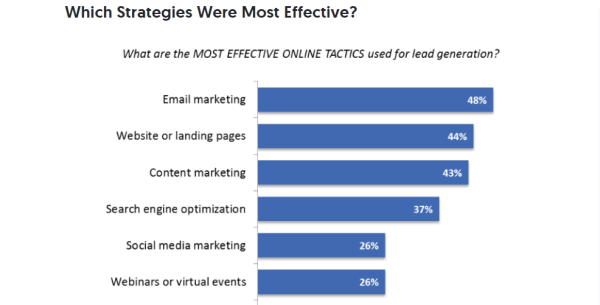
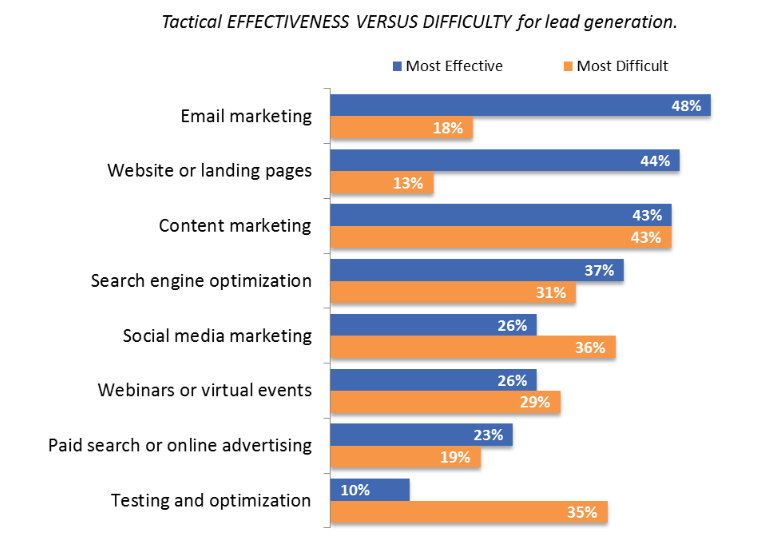
A study found that nearly half of all marketers see email marketing as the most successful tactic for producing leads on the internet.
A successful lead generation strategy can yield incredible results for your business. It involves creating campaigns that are tailored to appeal to your target audience and drive conversions. By utilizing effective tactics and techniques, you can generate leads that will help you reach your goals.
Additionally, you should also focus on creating content that resonates with your target audience and optimizing your campaigns for the best possible outcomes. With the right lead generation strategy in place, you can achieve amazing results for your business.
Advantages of lead generation to businesses include:
Increases brand awareness.
Helps you nurture your target audience.
Helps generate more revenue.
Strategies to Amplify Lead Generation Through Email Marketing
Since you now know the significance of having a lead generation strategy for your enterprise, let’s explore the different techniques for drawing in fresh sales leads.
1. Enhance your lead gen efforts through lead scoring
Marketing requires specific targeting, and lead scoring provides a way to ensure that only the most promising prospects are acquired. In doing so, it guarantees the delivery of the correct message to the right individuals at the right time.
Lead scoring can be a useful tool to order and prioritize leads. It is a good method of making sure that you are getting leads that are more likely to be interested in your emails.
Lead scoring can be utilized in your marketing efforts through the help of automated emails.
For example, it is more probable to get a conversion from a potential consumer if they have previously seen a certain item on your website. To further motivate them, you could send an email offering them 25% off on that same product.
When someone visits the product page and is not already included on your list, you can take advantage of the situation by displaying a pop-up with an exit intent as they are departing.
2. Create neat and straightforward emails
The design of your emails is critical for lead generation. To maintain your message’s focus, ensuring the emails are succinct is key. Avoid having a lot of extra details in the design of the templates, as it can be distracting. Here are some tips for creating successful emails:
Plain fonts: Make sure your emails are legible and not over-the-top by selecting standard fonts.
Simple look: Choose a template that is simple, as they are easy to read, helping you draw in customers.
Proper formatting: Utilize brief, well-formatted text and emphasize important points to make it easy for your subscribers to understand the content of your email.
Visible CTA: Make sure that the call-to-action button is easy to spot and click on, particularly for those who are using mobile devices.
3. Craft attention-grabbing subject lines
When crafting emails, it’s a good idea to use techniques such as bold, italic font, and emojis in order to draw the attention of the reader to the subject line, which is a critical part of the message. This can help to create a sense of curiosity or urgency.
Using this approach can produce a significant result on the effectiveness of your email campaign, as it can amplify your open rates and, in the end, your consumer conversion rates.
If you have a sports blog with a list of followers, it would be smart to concentrate on current sports stories to interact with them. Moreover, it would be beneficial to add a hint of suspense to pique the subscribers’ interest.
A prime example of a headline for a sports blog could be:
The Statement Made by Lebron James During Last Night’s Match was Astonishing
It is almost a guarantee that this will be opened due to people’s curiosity as to what was said by Lebron James. If the body of the email is enticing, viewers will be eager to read the story.
4. Incorporate a powerful call-to-action (CTA)
In order to have a successful email, it is essential to include a strong call-to-action (CTA). This CTA should be attention-grabbing and straightforward for the readers to understand and act upon. It is important to use creative language to ensure you are effectively conveying the desired message and inspiring the reader to take action.
To create CTAs that have an impact, it is important to include a feeling of urgency, excitement, or mystery. These will draw readers in and encourage them to take action, resulting in improved conversion rates.
Here are some tips to increase the effectiveness of your CTAs:
Use active text: Urge readers to take action through phrases such as “Grab the Deal”, “Reserve Your Seat,” or “Free Trial”.
Make it brief: As a guideline, keep your CTA text to a maximum of six words. If possible, try to stay within two to three.
Add a sense of urgency: Utilize calls-to-action like “Shop Now!”, “Only 3 Vacancies Left,” or “Discount of 60% Valid Today Only” to create a feeling of pressure and increase click-through rates.
5. Make use of content upgrades and gated content
By utilizing your most valuable content, content upgrades and gated content can be transformed into an email collection tool to increase your marketing efforts.
Content that can only be accessed after visitors submit their contact info is known as gated content. A content upgrade is one way to employ this technique and attract readers to sign up for an email list without being overly intrusive.
After readers go through a post on your blog, you can suggest they obtain a related ebook, article, report, etc. in exchange for their email address. Not only will this aid in long-term monetary gain from blogging, it will assist you in building up an email list quickly.
The advantage of this material is that it encourages lead generation. Content upgrades are especially advantageous since they are related and appropriate. The reader’s interest is pre-defined, increasing the probability that they will convert.
6. Utilize social media platforms
Using your social media accounts to bolster your email list can be incredibly beneficial. By adding a call-to-action to your profiles and scheduling regular posts about your free download, you can continuously generate leads without having to lift a finger.
It is important to advertise your email list on social media and your social accounts through your email list. Doing this will help to increase your social media followers as well as your email list. Utilizing Facebook and Twitter marketing tools can help you to achieve the greatest success on social media platforms.
Aside from the usual methods for increasing your email list, here are some other options for using your social media accounts to boost your subscriber count:
Enhance blog posts with content upgrades and then promote them on Pinterest for more website visitors and subscribers. Apps like Thrive Themes can come in handy.
Place a sign-up button and opt-in form on your Facebook page to give people more chances to join your list.
Utilize promoted pins and Facebook ads to increase your list faster.
Include click-to-tweets to your content upgrades so people can share your lead magnets with their circles and widen your reach.
7. Implement email automation
Using email automation software, it is possible to set up a system to dispatch bulk emails to specific contacts at predetermined intervals.
You can free up more of your time by implementing automated email marketing strategies. Furthermore, automated personalization can enhance your email campaigns.
The right emails can be sent to the right subscribers at the right time using specific triggers. For example, these triggers may be activated when customers:
8. Use split testing to raise open and click-through rates
It’s imperative that you deploy split testing and A/B testing on your emails if you want to optimize your content and overall approach. There is always area for improvement and by testing various versions of your emails, you can determine which ones produce the highest conversions and thus, improve your results.
When evaluating any email, first figure out which elements you need to assess. This may consist of the call-to-action, headline, body text, pictures, or the design of the email.
When you have pinpointed the components to assess initially, you can kick-start the A/B test using the internal testing tools in your email marketing platform.
9. Create valuable content
Rather than sending out emails for the sake of it, make sure that the content is meaningful and relevant to your email list subscribers to keep them interested.
The most important thing is to focus on giving your audience something of value. To do this, identify the pain points of your target audience and then develop content that is specific to those issues.
For example, if the primary issue for your readers is developing a successful online business, you can craft high-quality material that answers the question “How to build a lucrative website from the ground up” and then break it into subsections and send it out as a set of emails.
10. Offer rewards to current subscribers for referring others
Using your current customers and people who have already subscribed to your business can be an effective way of acquiring leads.
Incentivize your existing subscribers by providing attractive rewards if they refer their friends and family to your email list. This is much more straightforward than attempting to get them to send customers to buy your goods.
To maximize your conversions, it is wise to offer a reward, such as a discount on a future purchase. Make sure that what you are offering is of value, and your subscribers will be delighted to spread the word about your list to their family and friends.
Looking for ways to increase your lead gen efforts? Get Going In Business has been helping SaaS B2B companies turbocharge their lead generation for the last decade.
In a different world, the mere desire for business growth could be enough to make it a reality; however, in this world, you will need a marketing strategy and a sales outreach email.
And not just any kind of email.
The open rate of a cold email is usually estimated to be 1%. However, if the message is targeted, data from sources such as ConstantContact and MailChimp demonstrate the open rate to be between 14% and 23%.
In this article, we will take a comprehensive look into prospecting emails–what they are, why they’re a must-have, and how to craft them to generate new business.
Uncertain of which steps to take? The following strategies and methods can ensure an improved response rate to your sales outreach email campaigns.
What Is a Prospecting Email?
A prospecting email, more commonly known as a cold email, is the initial action you take when forming a new business partnership. Every relationship commences with some form of communication, either verbal or non-verbal.
Generating leads can come in the form of cold emails. It’s a situation in which you are reaching out to an unfamiliar person, not sure how they will respond. It’s almost like walking up to a random person on the street and offering your hand to shake, with the possibility they will not acknowledge you in any way.
Statistics from Oberlo demonstrate that email marketing is an effective technique that all companies should be utilizing. This is in comparison to the other channels that are used to bring in new contacts.
You may already be using popular approaches for salespeople such as attending trade shows, conferences, or related gatherings to scout out potential prospects. Rather than searching for opportunities to talk to and become acquainted with strangers, you can use a more intelligent strategy when it comes to email prospecting.
Now that we understand what a prospecting email is, why is it so important?
What Is the Value of Prospecting Emails?
As a sales professional, you are aware that prospecting is the first step in the sales cycle. Sending out a prospecting email is a guaranteed effective strategy for building your leads.
A cold email provides a range of benefits when done in the right way including a better-targeted list of contacts, a higher return on investment, and the opportunity to form deeper connections through personalized emails.
Improved Targeting Capabilities
A prospecting email is a superior alternative to commonly used methods of customer engagement. The advantages of aiming your emails to specific target audiences become crystal clear when the target groups are properly specified.
The specifications may include:
Number of employees
Physical address
Customer needs and wants
Problems faced
Greater Return on Investment
The advantage of doing business in the digital age is the rise in opportunities to form connections. Think about how many people you could come across if you were attending a conference, then compare that to how many people you could reach with an email in a single hour, including the time to write the message.
Think about the amount of money that will have to be allocated for the different methods of prospecting that you will use.
Taking trips to go to trade shows and/or conferences.
Paid advertising, such as through search engines, social media, TV spots, billboards, and so forth.
An effective prospecting email can result in leads that are better suited for closing sales, increasing your chances of making a profit. At this stage of the sales process, it is highly effective that you assess prospective customers. Trying to form relationships with an unqualified lead is a complete waste of time.
Best Practices for Crafting Sales Prospecting Emails
We have covered the “dos and don’ts” of a successful prospecting email, now let us see the best practices that will enable you to achieve great results.
Ensure Your Subject Line Is Captivating
As a general rule, you should capture the attention of the user within the first three seconds. The subject line is used for this purpose. Therefore, the words in the subject line are the most crucial in your entire email, since they determine if someone reads the email or not.
What to consider when writing your subject line:
Use current affairs, geography, specific contexts or pain points.
Use questions that increase engagement or pique your audience’s interest.
Highlight similar interests that build connections.
Create urgency in your message or FOMO.
Show them how they benefit.
Design an Effective Message Body
Your prospecting email should not imply what they can do for you but rather what you can do for them. It is even better if you show them how you can help them solve their pain points. Make sure they realize the advantage you or your goods/services can give them.
At this stage, personalize the content and ensure it considers the distinct needs, desires, and challenges of the target group.
Incorporate a Call to Action
Once you have curated an email that emphasizes the advantages you have presented to the recipient, remember to compose a clear CTA that requests something from them.
The following are recommended for creating an effective CTA.
Inquire if you can share with them a valuable product you have.
Request if they can verify a subscription or product.
Propose a suitable time to engage with them whether through a phone call or other appropriate ways.
Now let us look at the process to do this.
Qualify and Investigate Your Prospects
You are unlikely to contact random strangers on the street expecting to turn them into warm leads. Similarly, sending out cold emails to random addresses will certainly yield unsatisfying results.
Utilizing social media sites, corporate websites, and blogs can be an effective way to locate quality prospects. Nevertheless, it is necessary to stay up to date with the anti-spam regulations of your country as a precaution.
Use Lead Scoring for Ranking Leads
Individuals to possess distinct qualities, and this is also true of your prospects. Use lead scoring to change a lead into a paying client. This is done by utilizing a points system to grade your prospects depending on the probability of them making a purchase. The higher the score, the more attention and priority they should receive.
Prior to establishing your scoring process, you must do some groundwork.
The following are some things you should take into account:
What qualities do your top-tier leads typically have?
Assess if your sales prospects come from specific geographical contexts.
Don’t forget the fundamentals, such as industry, role, organization size, and any problems they are facing.
Constructing a scoring system for leads can be challenging, yet it is a worthwhile investment.
Send Timely Emails
In 2019, an extensive survey by GetResponse revealed 4 billion emails were sent in a period of five months. These emails were sent by a variety of people and businesses, such as online marketers, entrepreneurs, big companies, and small businesses.
The following are some of the findings:
Saturdays and Sundays had 18% of all email campaigns sent out.
Tuesdays followed close behind with 17%.
While Mondays and Tuesdays had higher open and click rates, the highest click-to-open ratio was seen on the weekend.
In 2019, a comprehensive study by CampaignMonitor uncovered the results of 30 billion emails sent. This research was in agreement with GetResponse’s findings that emails sent on Tuesdays had the highest open rate for emails.
However, Tuesdays also had the highest amount of unsubscribes.
Does the time of day make a difference?
It is confirmed by numerous studies, one of which is conducted by Sendinblue that 10 am and 3 pm to 4 pm are the best times to send emails, as this is when most people check their inboxes. Nevertheless, they have detected that the highest click-through rates are during the evening, up to 6 pm or sometimes 7 pm.
Create Follow-Up Emails
It is important to continue to pursue any chances that you may have missed. Do not just send one prospecting email and then move on. To get a better response, it is beneficial to use an email sequence in order to nurture your leads.
Did you know that only 48% of sales professionals take the time to follow up at all? That’s in contrast to the 60% of customers who refuse to buy a product or service until they have heard about the brand in four occasions.
Tips and Tricks for Successful Prospecting Emails
Articulate the value you offer clearly. What can you provide them that would be of benefit?
Provide them with a recommendation that will personalize the experience for them.
Communicate with recent testimonials.
Writing prospecting emails is actually not that difficult!
We’ve gone over quite a bit of material, right? Writing the ideal prospecting email could be the simplest part.
Considering the fact that time is money, when aiming to expand your outreach, you should try and make the process simpler. But don’t think that means taking shortcuts: attempting to cut corners will lead to a financial loss, not a gain, so don’t even think about it.
Are you ready to expand your venture with the ideal prospecting message? I believe you are!
GetGoinginBusiness is here to serve all your lead generating needs. Contact us Today!
In order to form a new business relationship, the first step is a prospecting email, commonly referred to as a cold email. This is the same as the start of any other relationship, whether it be through verbal or nonverbal communication.
Lead generation can be accomplished through cold emails, wherein you contact an unfamiliar individual not knowing what the result will be. It’s like walking up to a random person on the street and extending your hand in hopes of a handshake, but the likelihood of being ignored is also quite high.
Utilizing different channels to bring in new contacts is becoming common, however, according to the most recent data from Oberlo. Email marketing is a very useful tactic that all companies should include in their repertoire.
Salespeople often use trade shows, conferences, or other events to identify potential customers. There, you can spend your time searching for opportunities to meet and get to know new people, all of which is done to create a good relationship. But there is a better alternative.
It is obvious that there is a smarter way to do email prospecting. When you realize that just 24% of sales emails are opened, you cannot help but doubt the efficiency of this technique.
But now that we know what a prospecting email is, we have to ask – why is it so important?
What are the Benefits of Sending Out Sales Prospecting Emails?
In the sales cycle, the initial step is prospecting, a task that a salesperson is well aware of. One of the most effective methods to accomplish this is to use prospecting emails to build up their leads list.
When done properly, cold emailing can be a great asset, as it allows users to create a list of ideal prospects, produce a higher return on investment, and facilitate more meaningful connections with potential leads through customized messages
Rather than viewing it as another type of customer contact, a prospecting email should be seen as an improved option. When you craft emails that are well-targeted, you can expect several advantages, particularly when you form distinct segments. B2B marketers can’t help but sing the praises of email marketing. Email marketing is expected to generate $17.9 billion in revenue by 2027, making cold emailing a great investment.
Helps You Generate a Higher Return on Investment
The digital world has opened up a wealth of potential contacts. Whereas a person may only be able to meet a small number of individuals at a conference, emailing allows for far more people to be contacted in a short period of time (including the time it takes to create the message). The beauty of this lies in the increased opportunities for initiating contact.
Despite the benefits of having a face-to-face discussion, the purpose of a prospecting email is not to have this type of exchange right away. Instead, the aim is to turn a cold contact into a warmer one. It has been noted that email marketing returns a yield double that of cold calling, attending social events, or participating in trade shows.
Helps You Get More Suitable Leads
The crafting of a successful prospecting email can result in higher quality leads, making it easier to close sales. At this stage of the sales funnel, it is highly effective to qualify leads. Investing effort into developing a relationship with a bad lead is not a worthwhile use of time.
Best Ways to Perfect Your Sales Prospecting Emails
Let’s delve a bit further and examine the techniques to get the best results with your sales emails.
Use a Powerful Subject Line
It is essential for marketers to capture the reader’s attention within three seconds. This is where a powerful subject line is crucial. Additionally, these words can be the most significant elements of the entire email. The subject line will decide whether the user will open and read the content or not.
When creating your subject line, take the following into consideration.
Customize your headline by referencing places, current events, or matters of concern.
Ask a question.
Highlight any connections you have.
Generate a sense of urgency or fear of a loss of opportunity.
Identify a benefit.
Design an effective message
It may seem paradoxical, but your prospecting email shouldn’t be about what they can do for you, but rather what you can do for them. If you are able, explain how you provide a solution to their pain point. Make certain they understand the advantage that you or your product or service can offer them.
When delivering content, customization is key. If your reader base is segmented, this makes it simpler to identify what you can give them based on their wants, needs, and problems.
Incorporate a Call to Action
It is important to ensure that the message you are sending directly articulates the advantages that you have presented to the reader. Additionally, remember to include a clear and precise call to action in order to receive something in return.
Below are a few tips for crafting a compelling CTA.
Ask if you can send them some beneficial, like links to a blog post or a white paper. Request for confirmation on a certain topic.
Propose a precise time to have a conversation with them.
The first two attempts have a higher chance of success, but any attempts you make are an advancement towards a successful campaign.
The next step is the process to send the emails.
Analyze, Assess, and Qualify Potential Customers
Just like you wouldn’t approach strangers on the sidewalk in the expectation of converting them into potential customers, it is not advisable to send cold emails to random email addresses either.
One should check out social media, corporate websites, and blogs to search for potential customers. Make sure you know the anti-spam regulations of your country.
Lead Scoring: Assigning Numerical Values to Prospects to Prioritize Them
Every individual is distinctive and so are your prospects. It helps to use a strategy of lead scoring in order to convert a lead into a customer. This is done by assigning points to rank your prospects according to how likely it is that they will make a purchase. The more points a prospect has, the more attention and emphasis they should receive.
Prior to determining your scoring process, some groundwork should be done. Consider the following points for guidance:
What would you say is the typical character of your top prospects?
Looking back at your sales, is there an industry or region that they come from?
Don’t forget the fundamentals like sector, role, size of company, and the problems they are currently experiencing.
Constructing a lead score ranking system can be a time-consuming task, yet the benefit of doing so will be worth your time.
Find the Optimum Time to Send Emails
Five months of research in 2019 conducted by GetResponse concluded that 4 billion emails were sent by online marketers, entrepreneurs, large brands, and small businesses. Some noteworthy points to consider are:
On Saturdays and Sundays, 18% of all email campaigns were sent, and 17% were sent on Tuesdays.
Although Mondays and Tuesdays had a higher click-and-open rate, Saturdays and Sundays achieved the highest click-to-open ratios.
In 2019, a massive study conducted by CampaignMonitor included 30 billion emails. The evidence from this study was similar to GetResponse’s findings, with Tuesdays having the highest open rate. However, Tuesdays also experienced the most unsubscribes.
Is the time of day a factor that should be taken into consideration?
Studies conducted by Sendinblue have demonstrated that the best time to send emails is usually between 10 am and 4 am, when people tend to check their inboxes. However, the highest click-through rates were observed in the evening, from 6 pm to 7 pm.
Send Follow-Up Emails
Don’t limit yourself to just one prospecting email. To get the best results, use an email sequence to nurture your leads. Generally, follow-up emails are more successful than the original email.
Here is a helpful hint to keep in mind. 48% of sales representatives never follow up with prospective buyers, while 60% of customers take a great deal of persuasion before they make a purchase, requiring four “no’s” before they give a “yes”.
Tips for Successful Sales Prospecting
Much has been discussed regarding the concepts and principles supporting successful prospecting emails, so what about some tips when writing emails? Here are a few:
Articulate the substantial benefit to the customer.
Personalize the email and mention a person or a familiar company they’d recognize.
In order to make your prospecting email more personal, consider referencing any recent news or accomplishments that have been announced.
Prospective emails are not as difficult as you might think!
A lot of information has been covered, right? Crafting the ideal email for prospecting may be the simplest part. When you are looking to expand your outreach, it is important to remember that time is money. Taking shortcuts will end up costing you more in the long run, so it is best to commit to the whole process.
Get Going in Business is a great option to consider for efficiently managing and monitoring your prospects. It can automate the whole process.
Are you ready to expand your company using ideal lead generation emails? We certainly are! Your success is within reach with Get Going in Business. Contact us today.
It is estimated that about one-third of businesses operating with staff will close within the first two years, according to the SBA. Though this article isn’t going to explore all the reasons why a business might fail, it will emphasize one of the key components of success: regular lead generation. In order to increase your business growth, you must become proficient in acquiring leads for your business.
Lead Generation in Marketing
Generating leads in marketing is the process of obtaining potential customer interest in what your business offers. This can involve a customer taking the initiative to start a dialogue or providing information to be contacted about the company’s goods or services.
Let’s take a law firm, for instance. They could get leads would through:
A potential customer sends in a request through a form on their website regarding their services.
An individual looking to make use of the services books a consult on their website.
On social media, an inquiry is made about the rates.
Someone interested in the services sent an email to set up a consultation.
To discover new business opportunities, you need to design a marketing approach that facilitates customers interaction with your business. If you are questioning whether you require both demand generation and lead generation—the answer is yes.
One’s lead generation efforts should always end in obtaining a prospect’s contact info, payment information, or scheduling an in-person meeting.
Effective Lead Generation Activities
Creating a business lead generation plan is essential for transforming prospects into paying customers, regardless of whether you purchase leads or develop a lead generation marketing strategy.
Consider these twelve methods for bringing in leads for your enterprise.
1. Direct Interaction
The goal of lead generation in marketing is to create interest in a product or service. This is done by developing relationships with potential customers and presenting them with information that will help them make informed decisions.
For businesses that provide a pricey product or service that is charged on a regular subscription basis, talking directly to a possible client is an excellent way to bring in new business. However, if your revenue model is based on small-priced, high-volume sales, then this choice should be left out.
One can approach leads that may be a suitable match for their company by way of social media, email, telephone or even face-to-face after initial identification.
2. Generate Prospects on LinkedIn
It is important to be aware that LinkedIn users have double the purchasing power compared to regular web visitors. B2B marketing tactics implemented using LinkedIn can be particularly effective and can lead to very profitable outcomes.
Establishing ties with pertinent industry influencers is a fantastic way to create business prospects. Someone who is seeking your recommendations could potentially become a paying customer.
Promoting your business through social media platforms, such as LinkedIn, can be beneficial if you have the resources to do so. It is possible to purchase lead-generation ads that include forms that are integrated into the advertisement. This then allows users who are interested in your product or service to sign up quickly and easily.
To find business prospects through LinkedIn, you should connect with individuals who fit your target audience. Take part in their conversations and contact them with details of your product or service. However, you must ensure that your offering is relevant to their requirements; otherwise, your outreach may be misinterpreted as spam and damage your reputation.
3. Promote and Re-target
Advertising doesn’t have to be limited to social media! You can also use targeted pay-per-click advertising on Google or Bing to reach out to search engine users. This is a great way to show ads that are directly related to your business when people are searching for specific terms.
Suppose you’re a BMW dealership in North Carolina and you’re looking to augment your car dealership marketing. You can craft ads that are designed around expressions such as “superior BMW dealership in North Carolina” or “new BMW in North Carolina” and even make use of a geo-filter to aim at customers that are searching within the NC vicinity.
One must remember that very few web users convert during their first visit to your website. When a user clicks on your PPC ads, you can take advantage of display retargeting to present visuals of your offerings on other websites that are popular across the web.
It might take a bit of effort to perfect digital advertising, but it can prove to be a great way to cultivate leads for your enterprise.
4. Request Referrals from Existing Clients
Lead generation marketing strategies have been around for a long time, and one of the oldest is customer referrals. If a customer is delighted with a particular product or service, encourage them to tell friends who could possibly benefit from it.
The excellence of your business’s services may be so good that patrons could do this without reward, or you could create a reward system. For instance, you could offer your customers a percentage discount on their subsequent month’s retainer fee for every customer they refer.
Gaining additional leads for your enterprise through customer referrals is very advantageous and cost-effective, as your existing customers are the ones doing the majority of the work.
5. Create Content for Other Sites
Creating guest blogs is one way to get your content on other people’s websites. This will help you to reach a wider audience and gain more exposure to your work. Content marketing can be used to generate referral business opportunities and enhance SEO by writing guest blogs.
Guest blogging helps by:
Building relationships with other businesses in your sector
Enhancing your SEO with targeted backlinks from relevant sources
Attracting visitors from your target demographic through referral traffic
One way to uncover leads for your business is to post articles on sites related to your niche, but not in direct competition with you. Take, for instance, someone running a marketing firm. They could offer guest blogging on regional sign makers’ sites; the target audience of these sign makers are likely people who would be interested in marketing services.
When it comes to local SEO, having a guest blog post from local influencers is a great strategy. For example, getting a link from a popular podcast in the region will help your website rank better in that area. It is essential that the website you are guest blogging for is pertinent both to your field and where you are located for the best outcomes.
6. Boost Your Rank on SERPs
Ensure that those looking for your products or services online can easily identify you. Learn how to get more leads for your business by employingSEO and SEM for your website.
To begin, use keyword research to figure out the phrases your intended customers search for prior to acquiring your product or service. You can utilize tools such as SEMrush or the Google Ads Keyword Planner to get search information.
When you find the right terms to utilize, adjust the content on your page. If you’re marketing a very competitive product or service, it may be difficult to rank without help. Investing in an SEO company can be a great way to secure regular leads.
7. Respond to Queries on Discussion Boards
You can demonstrate your knowledge of a topic by responding to questions posted on forums. When done in a deliberate fashion, this can be a very effective method for quickly discovering new prospects.
As noted byInfluence at Work, the secret to utilizing the Principle of Reciprocity is to offer something first and make sure it is customized and unexpected. That way, you will get back something of equal or more worth.
Put the power of persuasion to work by responding to user queries on platforms such as Reddit or Quora. Identify a subject related to your business and begin answering questions. Finally, incorporate an invitation to use your product or service as a solution to the user’s issue.
Posting responses to inquiries in discussion groups can be an effective way to acquire new clients and increase your SEO. For instance, if your answer to a question on Reddit receives enough votes, the link can have a positive influence on the SEO of your company. When this happens, the efforts you put into generating leads can result in even better outcomes.
8. Create a Lead Generation Magnet
Generating B2B sales leads can be achieved by providing a free tool. What kind of difficulty does your product or service address? Can you offer a complimentary tool to aid users while not taking away the requirement to buy from you in the end?
If you were a plastic surgeon based in NC, you could find out what people wanted to know about your services by conducting a survey on Twitter and performing some keyword analysis. If you find out that the main things that individuals want to know are the cost of the procedures and how long the recovery period was, create an eBook.
Assemble an eBook that describes the cost, healing period, and before and after pictures for all the treatments you provide. You write a promotional blog post and then ask individuals to provide their name, phone number, and email address in exchange for the information you have given.
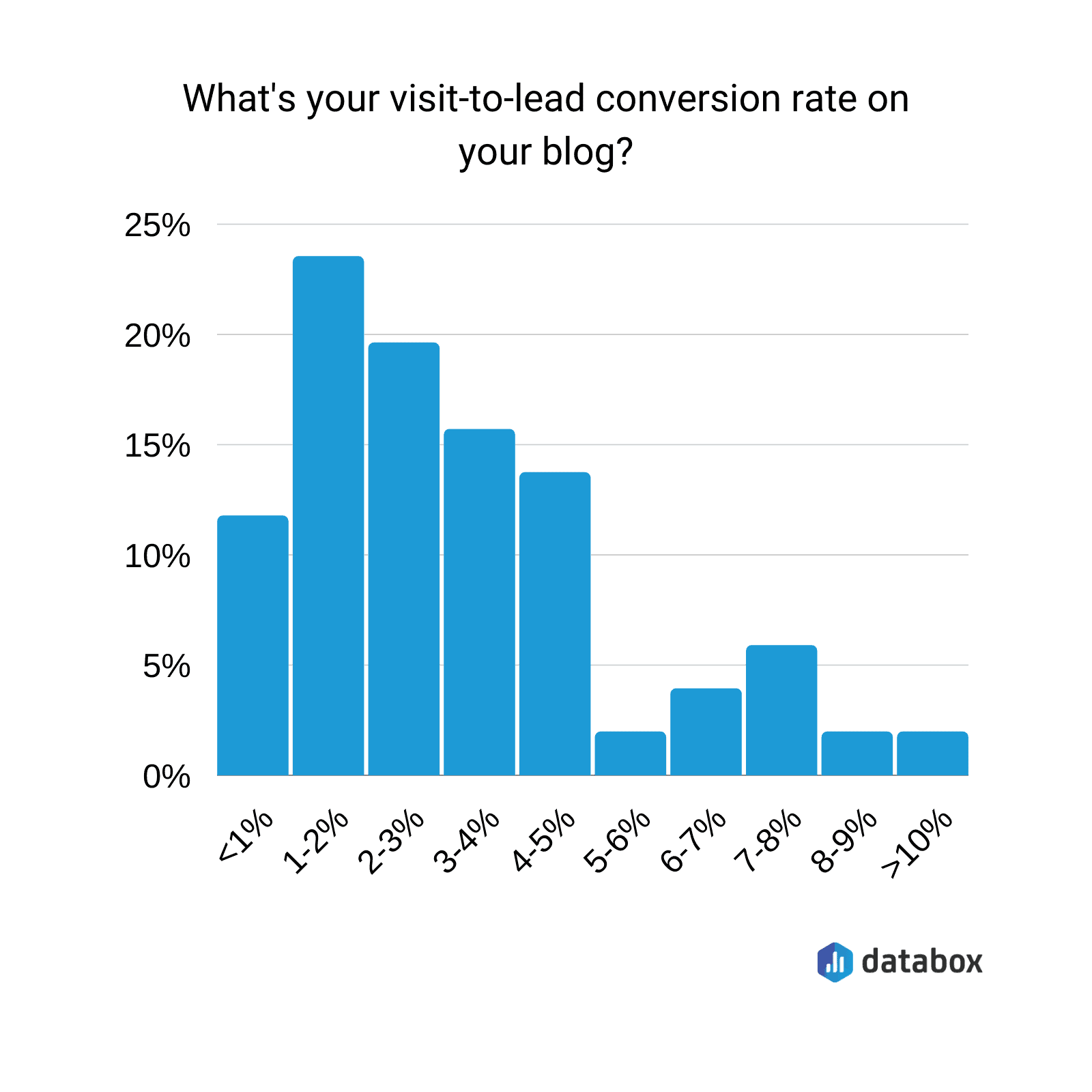
You can also have an informative blog post that will begin to acquire contact information if the correct subject, targeting, and call-to-action are incorporated. A better match between the blog topic, CTA, and offer will bring about a higher rate of conversion. According to blog lead conversion data from Databox, the typical visit-to-lead conversion rate that can be expected is presented below.
9. Interviews with Influencers
Talking to top people in your field of work can be a major advantage for yourself and your company. Not only is it a great way to expand your network and gain knowledge from established professionals within your industry, but it can also be used to generate compelling content.
Record an interview on video and transform it into a blog post Q&A format, or podcast it. Presenting the interview in these various forms will help you capitalize on the content and draw in interested web users or followers of your social media accounts. You may even think about using interviews as a means to collect contact information to increase lead generation for your business.
The influencers may further increase your return on investment by spreading the completed interview through their promotional networks.
10. Network
Making connections with people in your industry is a great way to get ahead and stay informed. Start networking today to build relationships that can help you in the long run.
Attending networking events does not usually result in immediate financial gain, but it can be beneficial for fostering professional relationships. To make the most of your experience, pick an event that is both close to your area and ties into your industry. This will help reduce your travel expenses, as well as offer you potential business opportunities.
When you participate in networking, don’t focus on the ROI; you’ll likely be unhappy with the result. Instead, aim to achieve indirect gains.
You could come across a like-minded business that you could collaborate with in order to extend the scope of your client base. Maybe you will run into an influencer who is willing to do an interview with you, allowing you to produce an excellent piece of content while simultaneously broadening your marketing range. Networking could even give you a chance to have your company guest blog.
Networking can be an incredibly beneficial tactic to generate leads for your company, as it usually brings multiple rewards.
11. Email Marketing Campaigns
Generating leads does not necessarily need to originate from reaching out to new viewers. You could take advantage of the undiscovered business possibilities in the email lists that you possess.
An email marketing campaign can convert even ice-cold subscribers into active purchasers. A discount or limited-time offer could be the motivating factor in a sale. You may want to consider sending out special email deals to other people’s mailing lists. If you are regularly participating in networking or collaborating with businesses in your field that are related to your own, you can design a campaign that allows you to advertise your business to their following.
The agency could then propose a promotional campaign to be featured in the sign company’s email, in exchange for 5% of all the sales originating from the campaign. This would be advantageous for all the involved parties: the agency, the sign-maker, and the satisfied customers.
12. Generate Beneficial Blog Commentary
It is important for business owners and marketing executives to stay up-to-date with industry publications and even their competitors’ blogs. This way, they can keep an eye on the competition and spot chances to be of assistance.
If readers have left several blog comments that haven’t been answered, it is worth considering providing your own insights in reply. Additionally, including a call to action that links to additional relevant information on your website can be beneficial to address the query.
When attempting to gain business leads through blog comments, one should exercise caution. Blog comments are often seen as spam, making it hard to be genuine. Additionally, other competitors may not be pleased if you try to acquire their readers.
Gaining extra customers for your business and expanding your firm can be made easier with the help of the professionals fromGet Going In Business. Our team ofmarketing experts can help you to enhance your lead generation, leading to a more successful bottom line.
For businesses to expand, they typically need to gain more customers. To help with this objective, it’s important to regularly obtain sales leads, since they’re one of the keys to successful business operations.
Your business could get a customer by identifying a sales lead, someone or an organization who has the potential to buy your goods or services. Once you have established their need and compatibility as a customer, they become a prospect. There are several ways to pinpoint leads, such as advertising, cold calling, social media, referrals, outreach, networking, consultations, and product/service trials.
Your business can benefit from inbound marketing techniques to generate ongoing inbound sales leads. However, while inbound lead gen creates brand awareness in general, the strategies below are more localized putting you in front of the exact market that needs your services or products.
Let’s look at some high-impact and affordable strategies for local businesses.
1. Ask your existing customers if they can give you referrals.
It is essential that your current customers be a part of your plan to draw in potential sales leads. They have already purchased from you and are aware of the value of your products and services. Referrals that come from people who know your business can be more effective than emails or other methods.
Here are a few ways to turn your existing customers into a reliable source of sales leads:
Make sure that your account manager is doing all that they can to ensure customer satisfaction and support. Ask them to look for ways to make the situation better.
Set up a meeting with your customer, and thank them for their patronage. Let them know that you appreciate their business and ask if there are ways in which you can add value to their relationship.
Request the details of any contacts and other businesses that may be in need of your product or service, as well as the reasons why they would benefit from it.
Encourage your customer to reach out to the potential client on your behalf, with an email or phone call. Supply them with what they should say in the email to make sure the sales lead comprehends your value.
Show your appreciation to your customer for the referral with a personalized gift. Make sure it is something unrelated to your company’s products and services.
2. Utilize your associates to discover potential customers.
When it comes to generating leads, we often overlook our personal networks of family, friends, colleagues, and acquaintances. These people have already earned our trust, which is why they should be considered as a first option for finding sales leads. These contacts may include past or current business associates, neighbors, and service professionals such as plumbers, doctors, lawyers, and landscapers.
Despite all knowing you, most of your network may not have any contact with each other. This means that each person could be a great source of sales opportunities. If you’ve had conversations with any of them about life and business, don’t hesitate to ask them to introduce you to potential customers.
To start the process, let your contacts know that you’re searching for someone or a business. Explain the industry, size of the business, sales, revenue, geographical location, etc. If your contacts have a connection to an individual or company, request that they reach out to make the introduction. Or, you can provide them with an email to forward to the desired contact.
Keep in mind that you’re dealing with people you intend to maintain amicable relationships with and remain connected to. Because you’re intermingling your personal and professional life, you should show consideration for the time they are investing and their relationship in general.
3. Attend networking events and interact with sales prospects.
Incorporate attending in-person and virtual networking events as part of your lead-finding mission. Networking is a successful method of making contact with new people and furthering existing connections. Moreover, it provides the opportunity to interact with your leads in person.
It is essential to select the right events for networking, as it requires time. To maximize your use of time, go to events where your sales leads are likely to be successful. Here are some tips to get the most out of the networking opportunities:
To build meaningful relationships, don’t approach people from a sales perspective. Show an interest in their business and in them as individuals, and try to determine how you can support them and their endeavors.
At in-person networking events, exchange business cards and make sure to enter the contact information into your customer relationship management system. Also, send them a thank you email within the week.
Additionally, when meeting someone in person or virtually, ask if they’d like to connect on LinkedIn; staying in touch can be a lot easier that way, especially if they move to another company.
Above all else, be genuine and enjoy yourself!
4. Take a second look at the opportunities that were previously shut down and those that were missed.
On occasion, a “no” could actually mean “not right now.”
It is likely that you contacted multiple companies that did not purchase from you right away. It is important to reach out to them again. Those companies are already familiar with your business and what it offers. You might have displayed your goods or services and even held a discussion call. They didn’t commit to a purchase at the time, but that could change if you reach out and try again.
Look back on any deals that didn’t pan out. Re-establish contact with the customer every four to six months. Ask about any changes that have occurred in their business such as their priorities, problems, ambitions, and requirements.
Businesses that have not already purchased from you are already qualified leads. Allocate effort and resources into promoting to these potential customers. Keep contact with them by means of blog articles, individualized messages, and authorized promotional emails.
It’s very possible that you won’t be able to close a sale in the first few attempts. However, after making contact with them multiple times, you may eventually find success. Remember too, that your prospect’s circumstances may change over time. It could be that they are now able to buy your product or even have moved to a company where it’s necessary to implement your solution.
Keeping yourself at the forefront of the minds of prospects will ensure that you are the first business they approach when they are ready to purchase.
5. Look for potential clients on social networks associated with your industry.
It’s likely that you are on LinkedIn (if not, you should be), therefore, use it to acquire supreme sales leads. The individuals and businesses in your area of expertise are present on LinkedIn as they are looking to do business, expand their network, publicize their commodities and services, and search for solutions to their business problems.
These strategies can be utilized to use your social media presence for the purpose of creating new business opportunities:
Reach out to existing relationships, sales leads, and those in your industry. All connections can give you a greater chance of success, and you don’t have to be personally acquainted with your contacts.
Make your contacts aware of the kind of people you are targeting and the type of problems you can help them with. You can share the message on social media or post an update. For example: “We want to help dentists and orthodontists in Denver to spread the word during the back-to-school season.”
Request two or three of your present clients to leave reviews or recommendations to illustrate your value and customer service.
Focusing on LinkedIn is a good strategy, but you can reach many more potential customers by expanding to other social media networks that fit your business. You should be selective when choosing what platforms to use, considering which ones are likely to generate the most sales leads. Examples of other networks you could explore include Instagram, Facebook for Business, Twitter, and Tiktok.
6. Modify your social media accounts to draw in potential customers who fit your ideal sales leads.
It is essential to maintain your social media accounts, such as LinkedIn, Twitter and Instagram, if you have them. Doing so will expand your customer base as it will capture the attention of potential buyers, thus making it simpler to connect.
LinkedIn
Crafting a strong headline and profile description can be an effective way to appeal to your desired buyers. Describe what you do and who you assist in your headline and summary. When constructing your headline, use phrases and keywords that your target market would use when searching. For instance, instead of referring to yourself as a “Sales Maven,” try something along the lines of “Sales Manager | Providing Solutions to Automotive Industry Human Resources Professionals.”
Twitter
Your profile should feature a title, a link to your company’s page, a professional profile image, a link to your LinkedIn, and relevant hashtags. Staying active is important, so follow accounts in your business sector, and those of prospective sales leads. Participate in conversations by retweeting and making comments.
Instagram
This visual-oriented social media outlet requires a professional profile picture, in addition to interesting and applicable images. Utilizing hashtags that could be of interest to potential customers is also recommended. Maintain a professional attitude, but have some fun with it.
7. Compose a series of emails.
A sequence of emails that are automatically delivered to a mailing list can be used to increase sales. Leverage email marketing to generate interest in your business services and products. There are two types of email series:
Trigger-based sequences: Emails can be sent out due to an individual’s activity, like browsing a website, buying an item, signing up for an email list, or failing to finish a purchase.
Time-based sequences: Alternatively, messages can be sent at designated times, like two weeks after a purchase is made, straight after signing up for a newsletter, or on an anniversary.
For the best results in luring sales leads, when writing a series of emails, it is important to have a specific objective. Each email should build up the previous one in order to increase the reader’s engagement. An example of this could be an email sequence where each one ends with a specific call to action, such as asking the reader to call for more info or click on a link to buy the product.
Email one: Introduce yourself and bring up an issue that may be familiar to your reader.
Email two: Describe how advantageous your product or service is.
Email three: Explain how a client was able to alleviate their issue through using your product or service.
Email four: Explain what services you offer to customers.
Email five: Give a rundown of advantages that come from using your product or service.
Email six: Send another communication with a unique offer.
8. Create educational and informative articles and blogs.
Creating a blog post or article can demonstrate one’s expertise in their field. Sharing what you know and how it could help others is essential. There are countless potential topics to cover, such as methods to become more efficient, decrease costs, boost sales, heighten productivity, and grow your venture, among others.
Putting your thoughts on paper will prove you to be an authority in your niche. People can read your words and discern that you are well-versed in your field. By educating readers, you will make yourself known. When they are in need of more information or wish to purchase something based on your teachings, you will be the one they seek out.
Including blogging as part of your content marketing campaign can be an effective way to increase website visitors and improve your lead generation process. Employing content marketing as part of your lead generation tactic can lead to more web traffic and guide potential customers to the desired web page.
On that page, a call to action can be implemented. Have one designed to prompt website visitors to take a desired action like getting more information, making a purchase, subscribing, or engaging in something else you want prospects to act on.
You can publish articles and blog posts in various places:
Your business’s website or blog.
Your social networks like LinkedIn, Instagram, or Facebook.
Other companies’ websites and even individual blogs as a guest writer.
Sites that post business and industry-related blog posts and articles.
Your clients’ websites.
You can also create a mailing list for delivering blog posts and articles. This approach has the advantage of fostering relations with your target market. People have to sign up for the newsletter, showing their interest in your content. With their consent, you can use this as a tool for marketing, as long as it is done in a way that educates, informs, or entertains them.
9. Hold a webinar or a virtual workshop.
Sharing knowledge and educating people through writing articles and blog posts is beneficial. Yet, it is considered a one-way conversation, where you write and someone else reads. Webinars and online workshops allow you to interact with people as you teach, creating more impactful sales leads.
Webinars and online workshops are great for providing prospects with an in-depth look at your knowledge. For instance, you could demonstrate a number of steps for creating a marketing campaign, using videos and images to help guide the way. Those who sign up for the webinar or workshop are potential sales leads, and it also helps to build your reputation as a leader in your industry and increases your capacity to draw leads.
Organizing webinars and online workshops that you can run live and answer questions in real-time is a great way to generate sales leads. Additionally, you can record the webinars and workshops for people to access at any time of the day, even when you’re not available. They could be hosted on your company website or any other webinar platform.
10. Reach out to people who are engaged in live chat.
Artificial intelligence and machine learning have taken chat technology to the next level. It is now possible to create a chatbot that reflects the look and feel of a company’s brand. When someone visits the website, they will be greeted by the chatbot with a personalized message.
Chatbots can be so much more than just “hello!” They can be an important part of your sales and marketing team. Some of the things that a chatbot can do include:
Respond to inquiries from sales leads in a manner that meets their needs.
Determine whether a sales lead is worth pursuing.
Schedule appointments and gatherings.
Provide answers to frequently asked questions.
Connect website visitors to the appropriate contact.
You can get further insight into prospective customers by examining the dialogue between the chatbot and the lead. This can help you to determine what you can contribute and how you can interact with the lead to improve the chatbot’s reactions.
Your local business can be as successful as a SaaS in a skyscraper in Silicon Valley using these strategies.
Take a break from thinking about your product for a minute.
Here is the truth: despite all the bells and whistles or attractive pricing, it still won’t make a difference if no one is aware that it exists. This is why marketing is so important for businesses. It’s a straightforward idea—those who have the most leads tend to be the most successful.
Gaining more leads is a win, even if your product is merely average. More leads bring in more income, and that, in turn, often translates to increased profit.
Here are 19 clever methods on how to generate leads for your business quickly.
1. Optimize your web pages to increase conversions
The beginning of all your endeavors to generate leads through the internet should begin with your website. It would be pointless to send people to your webpage, regardless of the source—it could be from Google, social media, or just verbal referrals—if they don’t take any action once they’re there.
For the purpose of getting people to take action, it is important that your website is optimized. For lead generation you need to collect the contact information of potential customers, like their name, email, phone, and other details that can be used to help with sales.
In this day and age, setting up a website is quite easy; however, this does not guarantee that the website is structured to efficiently collect leads. To ensure that you get the most leads possible, there are certain standards that every page on your website should follow.
If you’re not an expert, don’t worry!
There are plenty of tools, like Leadpages, that make crafting high-performance webpages as easy as sending an email. Other sites like Unbounce, Clickfunnels, Instapages, and GetResponse among others allow you to rapidly create and post webpages based on a tested formula of success. Their broad marketplace and collection of page templates can help even the newest beginner convert more leads.
If you are too occupied to create leads, you can always consider employing a specialist or a freelancer from Fiverr or Upwork.
2. Organize a giveaway or competition
Enticing prizes can help you generate a large number of emails and social leads in a short period of time when conducting a giveaway or contest. Brands offer a reward in exchange for individuals recommending the product to their friends, sharing content, and liking their social media accounts.
You can be imaginative with the prizes/rewards and the steps necessary to gather points (sharing, tagging, recommending, and so forth).
3. Interact directly with prospective customers
Making direct contact with customers should be of the utmost importance. Rather than direct interaction, many companies opt for things like FAQs. This strategy, however, does not yield the most successful results.
In contrast, employing direct contact with customers with tools like live chat conversations, forums, and help desks—where customer service team members are constantly available to make sure all inquiries are attended to correctly. Increased interest from customers leads to more positive discussions and more potential clients.
4. Utilize both outbound and inbound marketing tactics
Some stats suggest that outbound marketing is more successful than inbound marketing. But that doesn’t mean you should ignore inbound marketingit’s important to employ both strategies in order to help drive leads and your company’s growth.
To make your inbound marketing successful, it is essential to customize your emails and become involved in active online communities by consistently providing useful information and addressing customer issues. This will help to foster strong connections with customers and create more opportunities for lead generation.
5. Invest in modern technology
The latest technological advancements are influencing the market. Smartphones, for instance, have become increasingly popular around the world. Therefore, most people tend to use their phones or tablets to check emails or visit websites; this means that businesses should make sure their marketing campaigns are compatible with these devices so they can reach the highest number of customers.
It is essential to monitor developing technology and channels which can produce more leads for your enterprise.
6. Create and optimize relevant information
Providing content that is informative and speaks to your target audience can bring web traffic to your website, yielding more leads. It is critical that the content appeals to the desired demographic.
Your website can benefit greatly from excellent content, since it can bring in more visitors than just the ones who read it when you first post. Incorporating visuals, such as images, video, and infographics can further enhance engagement and the number of shares.
One suggestion is to employ InVideo if you need to generate high-quality videos quickly. This platform provides a range of templates to help you craft the perfect video.
7. Be expressive with your Tweets
Utilizing visuals with your Tweets can be a great way to capture the attention of your audience and make the content more engaging. Also, utilizing hashtags can make your content more discoverable. As you become more visible, your potential for gaining leads increases.
8. Utilize data to gain access to leads
Data.Com is a massive repository where one can find leads for their business. It has an extensive list of companies with precise contact information, making it easy to locate the appropriate leads in no time. Data.com furnishes an extensive collection of data quickly, and it might even lead to a 25% increase in sales.
9. Utilize LinkedIn for marketing
It is well known that LinkedIn is a website that is geared towards business. It can be a great resource for bringing in new customers to your company. Furthermore, users are able to post their content to an audience that is already interested in their niche.
10. Automating your marketing efforts
Rather than relying solely on manual work, you can now automate your marketing and lead generation process. This will help you save time and energy, and can ensure you get the desired results.
Platforms like Drip have created tools that can help you with your marketing automation needs. It offers a great design for pop ups and email marketing, allowing you to collect customer data and generate leads automatically.
You may wish to automate your social media marketing for lead generation. For example, Agorapulse, a social media management tool, can be utilized to automate Twitter/Facebook posts. Agorapulse has a case study about tweeting evergreen content on a large scale.
11. Respond to an inquiry on Quora
Quora is a question-and-answer based social platform that has a large user base from various backgrounds who are posing questions on a daily basis. If one responds to enough of these questions, users will come to recognize your profile and may even visit your business website.
12. Offer feedback on other blogs
By providing helpful and generous comments on blogs, one can get their name out there and eventually lead to potential customers. Being kind and generous with your responses will draw people to what you have to offer.
13. Begin writing posts for other blogs
Lead generation can be improved through guest blogging, provided the following rules are observed:
Audience members can find useful content in articles.
You direct readers to a suitable page on your website.
The post contains exclusively original material.
You actively share the post in order to gain social proof.
Your target the audience that highly values the website you blog for.
14. Show off your signature
Always add your email signature as a link that will take the readers to relevant and informative material. By integrating that link, you can expect an increase in web traffic to your content. It is essential to check that your HTML coding is functioning appropriately on all platforms when you include your signature in your emails.
15. Take part in discussion forums
By participating in forums, it is possible to become more familiar with customers. A greater understanding of customers makes it simpler to reach out to them with an offer. Take part in conversations on forums, express your opinions to other members, and provide answers to their inquiries.
16. Speak with influencers in interviews
Connect with influencers that your customers look up to and interview them for your blog or on your social media accounts. Keep it simple, asking straightforward questions. By showing your credibility this way, you are likely to draw in new potential customers and leads.
17. Post videos on YouTube for others to watch
YouTube is much more than a video hosting site; it is a gigantic web search engine. It is more frequently visited than any other social media network, including Facebook, Twitter, and Google+, with more than 14.3 billion visits a month. In contrast to other sites, posts on this platform remain available over a long time. Therefore, it is the ideal channel for generating permanent referral web traffic.
This platform provides an opportunity for you to create and manage a channel of your own, where you can upload clips, instructional videos, and more. This will help to distinguish you from your competitors and draw more potential customers to your business.
18. Provide free software on your website
Offering a user-friendly software application without any cost can help build confidence with your visitors. Neil Patel’s blog Quick Sprout offers a website analyzer for users, and Agorapulse provides free social media marketing tools for Facebook and Twitter. Leads are generated when trust is established.
19. Incorporate a Quiz into your blog
Creating a quiz on your blog can be an effective way to engage your audience and attract more visitors. It can encourage readers to make comments and give their opinion on your posts, which can help you build relationships with them and bring long-term leads.
Creating a quiz for your blog is made easy with the utilization of QuickBox, a free utility that guides you through the process in a few straightforward steps.
We hope these lead generation strategies will help you start generating leads for your business. Never stop testing. Try every strategy and keep improving what works to improve your lead quality.
ds for your business. Never stop testing. Try every strategy and keep improving what works to improve your lead quality.
It can feel like an uphill battle to generate enough inbound sales leads to make marketing campaigns profitable. We have been there ourselves and know what it is like because we have experienced the same thing. Every successful marketing team has to struggle with testing too many strategies and variables until they get what works best for them.
After years of experimenting, we finally discovered the right formula and the truth is that getting the basics exactly right is all it takes. Here are ten ways to generate inbound sales, and once you understand them, they will continue to work wonders for you with little maintenance.
1. Let your Blog be a Valuable Resource
According to the HubSpot State of Inbound 2018 Report, 61% of marketers consider blogging their number one inbound marketing strategy, while 61% cite generating traffic and leads as their biggest ongoing challenge.
In contrast, Ahrefs’ research reveals that 91% of online content receives no Google traffic whatsoever.
It’s no wonder that traffic and leads are major concerns for marketers, but what’s going on here?
The Ahrefs study identified two primary reasons content is not getting the traffic it deserves:
Lack of user intent when creating content. The new Google algorithm in 2022 gives a clear picture of how important user intent is when creating content. Google prefers content by people, for people. Creating content that people won’t look for completely removes you from the search process.
Lack of backlinks. One of the most important ranking factors by Google is having backlinks. Chances are you’re not going to be visible on SERPs if you don’t have links.
You must make your blog a valuable online resource to turn it into an inbound lead generation tool. You must discover what difficulties your target audience is facing (business management, purchasing choices, work-life balance – whatever) and strive to create the best online resource for them.
Creating content that people actually engage with is what the other 9% of the people are doing, and it’s what converts their blogs into inbound sales generating vehicles.
2. Creating Evergreen Email Content
With your blog being constantly updated with valuable content, you will produce long-lasting evergreen emails that provide some of the best ideas in your industry. You must provide cutting-edge content with headlines people find difficult to resist. Something that turns even the ice-cold traffic into potential customers.
Preferably, this content has to be so excellent that people are almost willing to pay for it. Unless you plan to give it away for free—all they need to do is download it and give up their email address—you must give them something of excellent quality.
3. Go on Social and Promote Your Content
Well, if you’re creating attention-grabbing and evergreen content on your blogs and emails, why not boost your reach by posting it on social media? To optimize your reach, have a mix of organic and paid social media strategies depending on the networks you’re advertising on.
It’s still possible to generate organic traffic from Twitter without paying for ads, but it’s very difficult to do so from Facebook these days. On the other hand, Twitter ads are quite expensive and Facebook’s ad targeting options will take your marketing to the next level.
We suggest focusing on paid ads on Facebook and using Twitter to reach a wider audience organically in this scenario. You still want to do the necessary organic work on Facebook—post your content, engage with relevant pages and groups, etc. But keep in mind that you must pay for ads to get the reach you need.
4. Write Guest Posts
By now, you should be used to publishing industry-leading content and you have your blog to prove it. The next step is to reach out to industry-leading online publications and offer to write for them.
By collaborating with other businesses, you can reach a new audience with the same interests as the people you want to generate leads from. Show these people what distinguishes you from other companies in your field, and give them a reason to learn more about your company.
5. Use Pay Per Click (PPC) Ads
Creating the content you need and getting it to rank well in search is a time-consuming strategy. One excellent way to generate consistent inbound sales leads is through PPC advertising. This works instantly.
With organic content-driven inbound marketing strategies, you largely generate leads from people who are very interested in your products or services, but they are not yet ready to purchase them. Even after a lead has expressed interest in your product, you still have to nurture him or her along the sales funnel.
However, there is a small (and highly profitable) group of people who have already decided to purchase what you are offering; they just haven’t decided where they will purchase it yet.
People search “best email marketing software for large retailers,” “top PPC agencies in Manchester,” or “emergency plumber near me Sunday” to discover the best providers.
Google Ads allows you to get your brand seen by these people at the crucial moment when they are ready to buy.
6. Set up Remarketing Campaigns to Reach Visitors Who Leave without Converting.
Google Ads is a great way to capture inbound sales leads from people who are ready to buy now, but not everyone is willing to pay immediately. Some people may get cold feet, go back to the results page, and check out the competition.
Well, don’t panic, it happens.
You can keep reaching out to these prospects and keep them on-board with your brand with remarketing. You already know that these leads are really interested in your service/product since they clicked your ad. Give them an extra incentive to return to your site and close the deal.
7. Public Speaking at Industry Events
Face-to-face contact is still one of the greatest inbound lead generation methods. You can become a real industry leader by speaking at industry events, where people will pay to hear you. CEO of Venture Harbour, Marcus Taylor, after speaking at every marketing event from 2012 to 2015, realized that speaking at big conferences is largely ineffective.
“First of all, there are too many competitors pitching for the prospect’s attention. It’s like trying to promote your book in a bookstore: Unless you have something truly exceptional to say, you’re soon forgotten. The bigger problem, though, is that most of the audience assumes that you’ll be busy after your talk – so relatively few people come up to speak to you.”
Instead of attending events such as TEDx, you’ll generate higher volumes of genuine leads by speaking at events with 50-100 people. So look for small-audience speaking engagements to generate face-to-face inbound sales leads.
8. Have Multi-Step Forms to Maximize Inbound Lead Generation
There are a lot of impediments to converting website visitors into inbound leads, but one of the largest is keeping them engaged with them as their needs evolve. Having the ability to convert traffic into email sign-ups via is one of the most effective ways to do this. Email marketing segments your leads and addresses their pain points as you lead them along their buying journey.
Fortunately, you already have all of the sign-up content for email subscribers, but you still have to address the fact that most brands have average conversion rates of about 2.35%. Don’t settle for mediocrity, though. Work on your page content, headlines, and CTAs to get people excited about your offer. You can boost conversion rates by up to 300% by using multi-step forms.
Multi-step forms reduce form friction, increase incentive, and segment leads in order to increase conversion rates and help generate high-quality leads.
9. Automate your Inbound Sales Strategy
Once you know that your inbound lead generation strategies are working, you want to automate as much of each process as possible. Reducing the manual workload of your wider inbound marketing strategy, you’ll increase the number of leads you can generate.
At Get Going in Business, we help you automate your lead generation process. We’ll help get prospects to your door, build a database and automate the prospect follow-up process, and have your prospect book your calendar.
You can also automate most of your email marketing strategy, technical SEO reporting, lead segmentation, and much of your social media activity. Tedious daily tasks such as creating quotes and proposals, invoicing, accounting, etc. can also be automated. If you automate these processes, your lead generation results will skyrocket.
10. Automate your Sales Process
Your inbound lead generation strategy is bringing in more prospects than you ever imagined, and now the challenge is how to handle all of those leads. You have two choices: build a bigger sales team to handle the surge, or you can automate your sales process so that your existing workforce can still take care of everything—which is much more economical.
By automating the sales process from the moment users submit their email addresses, you are able to nurture them along the sales process without any (or minimal) manual input. Your sales team only needs to get involved when a lead drops outside of the automation processes, fails to respond, or contacts your teams contact for any reason.
Wrapping Up
You may be thinking at this point that you already have a wonderful blog and it is not bringing in enough leads or that paid advertising is too expensive. It’s true; these things are difficult. But if your blog isn’t producing enough leads.
If you’ve tried these strategies before and they didn’t work for you, give them another shot and put in the time and effort to get the basics right (great content, compelling ads, etc.). And if you haven’t used any of these techniques yet, now is the time to put them into action in your marketing process.