Most law firms can tell you what they spent on marketing last month. Very few can tell you what they got back.
Ask a managing partner: “Of the $20,000 you spent on marketing in March, how much came back as signed retainers?” The honest answer, at most firms, is some version of “we think it’s working” or “the agency says it’s working.” Neither is a number. Neither is an answer.
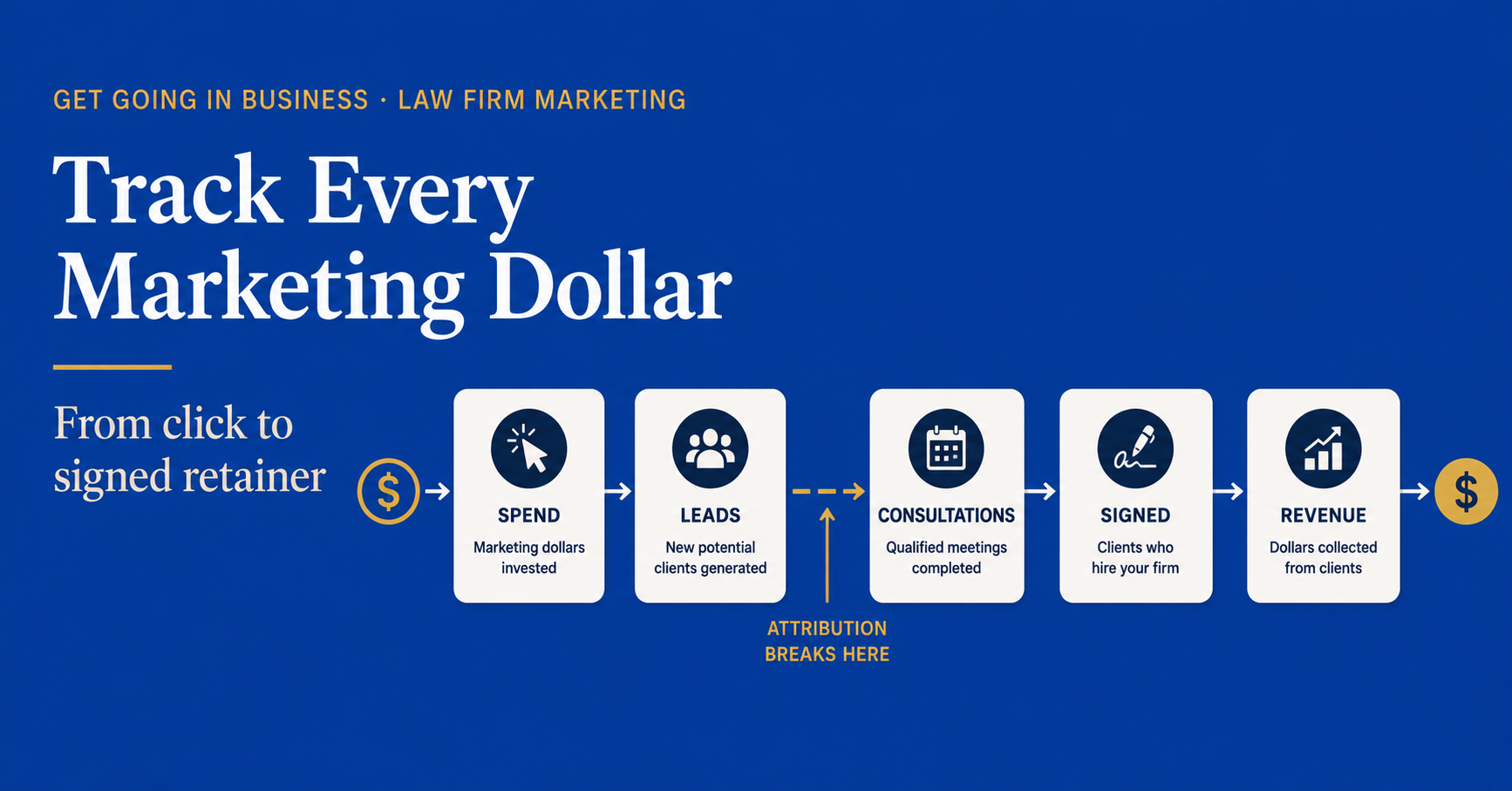
Law firm marketing ROI how to track is not a tooling problem. It is a chain-of-custody problem. Every signed client started as a click, a phone call, or a referral. Between that first touch and the signed retainer, the trail has to stay intact. At most firms, the trail breaks in five specific places, and every dollar of attribution past the break is guesswork.
Here is the full attribution chain, where it breaks, and how to fix every link.
Why “ROI” Is the Wrong Word for Most Law Firms
Strictly, ROI means (Revenue – Cost) / Cost. For a law firm, that calculation has two problems.
First, revenue is delayed. A signed retainer in March might not produce billed revenue until July or later. Personal injury firms see this most acutely; a case signed today might not pay out for 18 months.
Second, attribution is messy. A signed client may have seen your ad in January, your blog post in February, asked a friend about you in March, and called you in April. Which marketing dollar gets the credit?
So when law firms talk about marketing ROI, what they usually mean and what they should measure is cost per signed client, segmented by source. That is the practical version of ROI. It is calculable, it is reliable, and it produces decisions.
The 5-Number Attribution Chain
Every law firm marketing dollar passes through five stages between spend and signed retainer. To track ROI, you have to capture the number at each stage and connect them in one system.
Stage 1: Spend
How much you spent, by channel, in a given month. PPC ad spend plus agency fees. SEO retainer plus content costs. Referral program payouts. Software licenses for marketing tools. Time cost of any in-house marketing staff. Add it all up by source.
Most firms have this number. They just have it scattered across invoices, credit card statements, and the marketing manager’s head. Pull it into one spreadsheet. That is Stage 1.
Stage 2: Leads
How many qualified leads came from each source. A qualified lead is someone who reached out about a matter you handle, in your service area, in a state of need. Tire kickers, wrong jurisdiction, and out-of-scope inquiries do not count.
This is where the first major break happens. Your PPC platform counts “conversions” (form fills, click-to-calls). Your call tracking counts “calls.” Your website counts “contact form submissions.” Without source tagging, you cannot tell which leads came from which channel. UTM parameters and dedicated phone numbers fix this.
Stage 3: Consultations
How many of those leads became booked consultations. This is your intake conversion rate, but the part that matters for ROI is the source tagging staying intact. When a lead becomes a consultation in your CRM, the source field has to carry over. If it does not, every consultation looks the same and you lose the attribution thread.
Stage 4: Signed Retainers
How many consultations became signed clients. Again, the source has to follow the record. A signed client without an attached source is an unattributable win. It happened, but you cannot learn from it. Build the workflow so that no retainer can be marked “signed” in your system without a confirmed source field.
Stage 5: Case Value
What each signed client is worth. For flat-fee work, this is the fee. For contingency work, this is the expected case value (use historical averages by case type). For hourly work, this is total billings expected over the lifetime of the matter.
Once you have spend, leads, consultations, signed, and case value all tagged by source, you can calculate true ROI on every dollar.
Most law firms can track Stage 1 and Stage 5 perfectly. They lose visibility between Stages 2, 3, and 4. That is where 80 percent of the attribution problem lives.
Where the Chain Breaks (And How to Fix Each Break)
Here are the five most common attribution breaks at law firms, in order of how often we see them.
Break 1: No source tagging on inbound calls
Your PPC ad shows your firm’s main phone number. Your Google Business Profile shows the same number. Your website shows the same number. When a call comes in, intake has no idea which channel produced it. They just answer the phone.
Fix: use dynamic call tracking. Each channel gets its own number, displayed only when a visitor arrives from that channel. The intake team still answers normally, but the call recording shows source automatically. Cost: $30 to $200 per month depending on volume. ROI on this single fix is usually massive.
Break 2: UTM parameters not flowing into the CRM
Your PPC agency tags their links with UTM parameters. Those parameters get to your website. They do not get to your CRM. So when a lead fills out a contact form from a PPC click, the CRM record shows the lead but not the source.
Fix: configure your contact form to capture UTM parameters as hidden fields and pass them to your CRM. Most modern CRMs support this natively; most older ones can be wired in by a developer in 2 to 4 hours. One-time fix, permanent attribution.
Break 3: Intake team not asking “how did you hear about us”
Even with technical tracking, the question still matters. Many leads come from multiple touches: an ad click in March, a referral conversation in April. Only the lead can tell you which one tipped the decision. If your intake team is not asking, you are missing data the system cannot capture.
Fix: add the question to your intake script as a required field. Train the team to ask it conversationally early in the call, not as the last question. Track answers monthly to see how they compare against your technical tracking. Where they disagree is where you learn the most.
Break 4: Source field gets overwritten when leads convert
A lead comes in tagged “PPC.” The intake coordinator opens the record and changes the source to “Phone” because that is how they took the inquiry. The original source is gone. Every report from this point forward is wrong.
Fix: lock the original source field in your CRM. Add a separate “intake channel” field for how the conversation happened. Two different things, two different fields, neither one overwrites the other.
Break 5: Signed clients do not get tied back to original lead
This is the worst break. A consultation goes well, the client decides to sign two weeks later, and the retainer gets created as a new record in the CRM instead of attached to the original lead. The lead-to-signed chain is severed. You see the lead. You see the signed client. You cannot connect them.
Fix: enforce that every signed retainer must be linked to an existing lead record. If a signed client has no matching lead, create the lead first, mark it as “walk-in” or “referral” or whatever the actual source was, then attach the retainer. No orphan retainers.
The Tools That Make This Possible
You do not need expensive software to track law firm marketing ROI. You need software that does three things and software that does them in a connected way.
Tool 1: A CRM that captures and locks source data
Any modern legal CRM (Clio Grow, Lawmatics, Lead Docket, etc.) can do this if configured properly. The question is not which CRM, but whether someone has actually configured the source workflow correctly. At most firms, the answer is no.
Tool 2: A call tracking platform with dynamic numbers
CallRail, CallTrackingMetrics, WhatConverts. All work fine. The key feature is dynamic number insertion: each channel shows a different number to visitors so the call source is captured automatically.
Tool 3: A reporting layer that ties them together
Once spend, leads, consultations, retainers, and case value are all tagged by source, you need a single view that shows them next to each other by month. This can be a Google Sheet pulled together by hand, or it can be a dashboard built in Looker Studio. Either works. The point is one view, refreshed regularly.
If you want a deeper walkthrough of what to put in that view, see our companion guide on building a law firm marketing dashboard.
What ROI Tracking Looks Like When It Is Working
Once the chain is intact, you can answer questions like:
- “Our PPC spend produced $X in signed cases last quarter. Is that enough?”
- “Our SEO retainer costs $4,000 a month. It produced 3 signed clients last quarter. At $6,000 average case value, that is positive ROI. Should we increase the retainer?”
- “40 percent of our signed clients come from referrals. We spend zero on referral cultivation. Where is the highest-leverage investment?”
- “Our cost per signed client from PPC is $1,800. From SEO it is $450. Both are profitable. Where do we put the next $5,000 a month?”
These questions used to be impossible. They become routine once the attribution chain is solid.
How Long This Takes to Build
Realistically, a small firm with no current tracking can have all five stages connected within 30 to 45 days. The technical setup (call tracking, UTM parameters, CRM source fields) is 1 to 2 weeks of work. The behavioral setup (intake team asking the source question, source field discipline, no orphan retainers) takes 30 to 60 days of consistency.
Most firms try to fix attribution all at once and give up. The order that works: call tracking first, then UTM-to-CRM, then intake script changes, then CRM field locks, then orphan retainer cleanup. One per week. Done in 5 weeks.
Frequently Asked Questions
How accurate does law firm marketing ROI tracking need to be?
85 to 90 percent accurate is enough. Perfect attribution is impossible because some clients have many touches. The goal is not perfection. The goal is accurate enough that you can confidently shift budget between channels and see the result.
What about referrals? How do I track ROI on those?
Referrals are the highest-ROI source for most firms and also the hardest to track formally. Build a simple referral source field in your CRM with the name of the referring person or firm. Once a year, calculate average revenue per referring source. The number will surprise you.
Should I share ROI numbers with my marketing agency?
Yes, always. An agency that does not have access to your signed-client data cannot optimize against it. Sharing the numbers also tells you something: agencies that respond by changing their approach are partners. Agencies that respond by explaining why your numbers are wrong are not.
What if my CRM does not support source tracking?
Then you have a CRM problem, not a tracking problem. Any CRM purchased in the last 5 years supports it. If yours does not, the cost of switching is almost certainly less than the cost of running blind on attribution.
Get Help Building Your Attribution Chain
If you read this and recognized at least one break in your own chain, you are normal. Most firms have at least three. The fix is sequential and concrete, and we have walked dozens of firms through it. We can map your current chain, identify the breaks, and give you a 30-day plan to close them.
Want help tracking marketing ROI from ad click to signed retainer?
Book your free 15-min strategy call at getgoinginbusiness.com
Related: How to Build a Law Firm Marketing Dashboard That Actually Makes Sense →