This is the question every managing partner asks at least once a year. Sometimes after a slow quarter. Sometimes after a competitor opens a new office. Sometimes just sitting at their desk wondering if the firm is spending too much, too little, or the wrong way.
The honest answer is that the right number is not a number. It is a percentage of gross revenue, calibrated by practice area, growth stage, and what your competitors are doing in your market.
This law firm marketing budget breakdown gives you the actual benchmarks, the allocation framework, and the practical math to set the right number for your firm.
The Headline Number: 2 to 10 Percent of Gross Revenue
Most well-run law firms spend between 2 and 10 percent of gross revenue on marketing. That is a wide range, and the spread is intentional. Where your firm should land inside that range depends on three factors.
Factor 1: Practice area
Some practice areas live and die on marketing volume. Others run almost entirely on referrals. The numbers reflect that.
- Personal injury: 6 to 12 percent (high lead acquisition cost, high case value)
- Mass torts and class action: 8 to 15 percent (extreme acquisition cost)
- Family law: 4 to 8 percent (moderate lead cost, mixed channels)
- Criminal defense: 5 to 9 percent (urgent need-state, paid channels work well)
- Estate planning: 3 to 6 percent (referral-heavy, moderate paid)
- Business law and corporate: 2 to 5 percent (relationship-driven, lower paid spend)
- Bankruptcy: 5 to 10 percent (high paid lead volume, low case value)
These are real benchmarks, not aspirational targets. A personal injury firm spending 3 percent of revenue on marketing is underspending. A business law firm spending 8 percent is probably overspending.
Factor 2: Growth stage
Firms in different stages should spend different percentages of their revenue.
- Startup (year 0 to 2): 10 to 15 percent. Building awareness from zero requires heavy front-loading.
- Growth (year 3 to 7): 6 to 10 percent. Establishing predictable lead flow.
- Mature (year 8+): 3 to 6 percent. Maintaining position, optimizing rather than expanding.
- Scaling (multiple offices, new practice areas): 8 to 12 percent. New markets require new investment.
A mature estate planning firm with 30 years of referrals does not need to spend like a brand-new personal injury startup. The headline number is the same range, but the right slice of the range is different.
Factor 3: Local market competition
If three other personal injury firms in your market spend $80,000 a month on PPC, you cannot compete on the same keywords for $5,000 a month. Marketing budget is partially a function of what the auction looks like in your local market.
Pull SEMrush or SpyFu data on your top three local competitors. Estimate their monthly ad spend. If they are spending more than 2x what you are, you have a structural problem that no clever creative can fix.
The Allocation: Where the Money Actually Goes
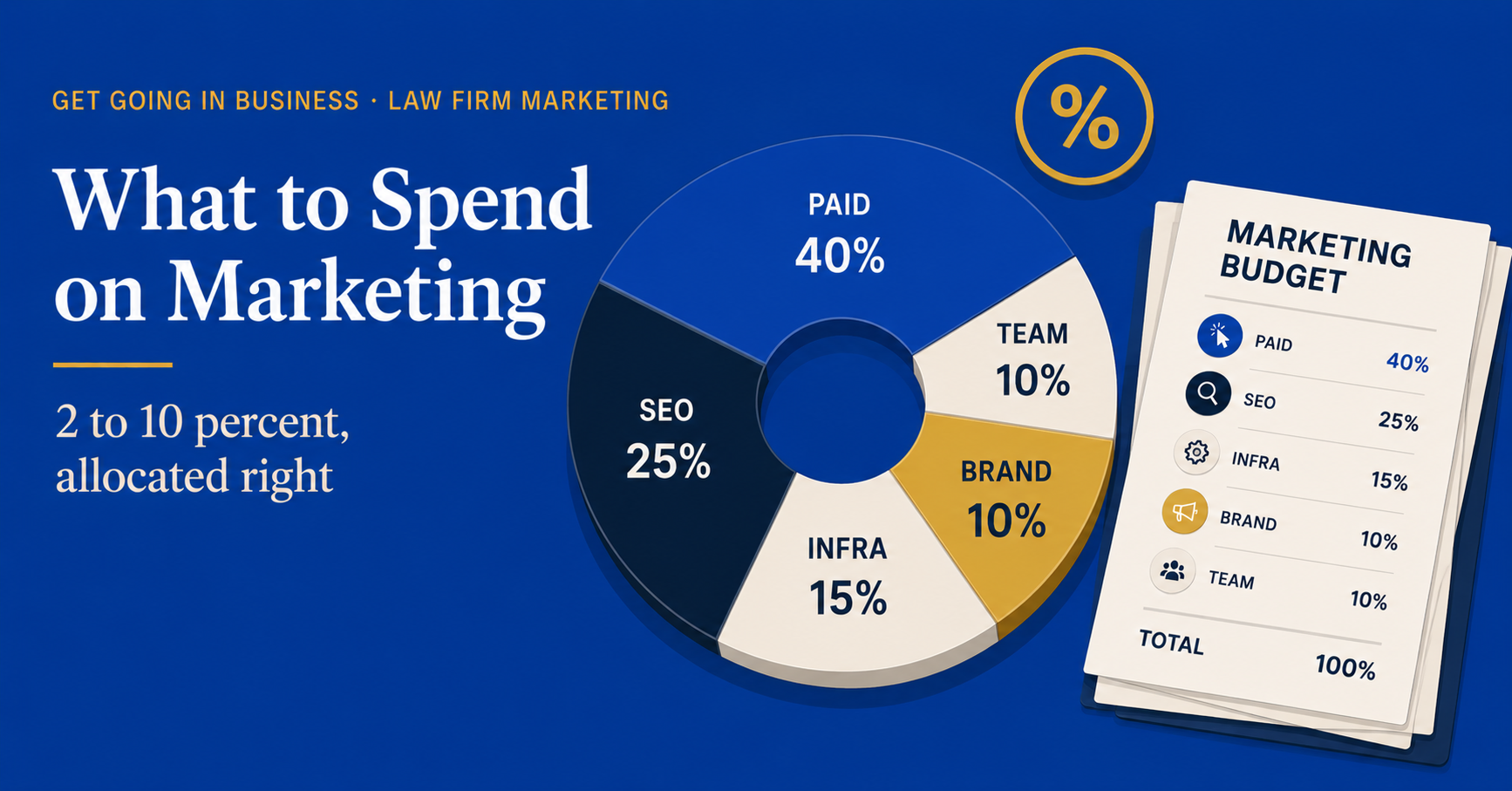
Once you have set the total number, you need to allocate it across categories. Here is the typical breakdown for a healthy law firm marketing budget.
Paid acquisition: 40 to 60 percent
Google Ads, Bing Ads, Facebook, Local Service Ads, and any other paid channels. This is the largest category for most firms because it is the most controllable. You can turn it up, turn it down, and measure it weekly.
Content and SEO: 15 to 25 percent
Blog content, on-page SEO, technical SEO, local citations, and link-building. SEO is the slowest-yielding category and the one most firms underinvest in for that reason. Firms that invest consistently here outperform their PPC-only peers within 18 months.
Website and infrastructure: 5 to 10 percent
Hosting, CRM subscriptions, call tracking, design updates, landing page tools, marketing automation. The infrastructure category is small but mission-critical. Underspending here breaks everything else.
Brand and reputation: 5 to 10 percent
Review generation software, PR, sponsorships, community events, branded content. This category is hard to measure month-to-month but has compounding returns over time.
Team and management: 15 to 25 percent
In-house marketing staff, agency retainers, marketing consultants. This is where most firms either over-invest (too many vendors) or under-invest (no one truly owns marketing).
If your vendor stack is bloated, this category is silently eating into the others. We covered the structural fix in our companion guide on how to audit your law firm’s marketing vendors. The allocation framework only works if your vendor stack is clean.
Allocation matters as much as the total number. A firm spending 8 percent of revenue with 90 percent of it on paid ads is not running balanced marketing. They are running a paid-ads experiment with a website attached.
Worked Example: A $2M Family Law Firm
Let’s walk through what this looks like for a real-sized firm.
- Annual revenue: $2,000,000
- Practice area: Family law
- Growth stage: Growth (year 5)
- Recommended marketing budget: 6 percent = $120,000/year, or $10,000/month
Monthly allocation:
- Paid acquisition (50 percent): $5,000 (Google Ads + LSAs + Facebook)
- Content and SEO (20 percent): $2,000 (content writer + SEO consultant)
- Website and infrastructure (8 percent): $800 (CRM + call tracking + hosting)
- Brand and reputation (7 percent): $700 (review tool + occasional sponsorship)
- Team and management (15 percent): $1,500 (fractional marketing manager)
This firm has a clear budget, clear allocations, and clear accountability. They can ask in any monthly review: which category produced what?
Worked Example: A $750K Estate Planning Firm
Smaller firm, different practice area, different math.
- Annual revenue: $750,000
- Practice area: Estate planning
- Growth stage: Growth (year 4)
- Recommended marketing budget: 4 percent = $30,000/year, or $2,500/month
Monthly allocation:
- Paid acquisition (40 percent): $1,000 (light Google Ads only)
- Content and SEO (25 percent): $625 (one blog post per month + SEO basics)
- Website and infrastructure (10 percent): $250 (CRM + minimal call tracking)
- Brand and reputation (10 percent): $250 (review tool + referral program)
- Team and management (15 percent): $375 (occasional consultant)
Estate planning firms get most of their cases from referrals, so the paid acquisition slice is smaller and the brand and reputation slice is proportionally larger. A 4 percent budget here is healthier than an 8 percent budget that goes mostly to ads that do not match the practice area’s natural funnel.
Signs You Are Spending Wrong
If any of these are true at your firm, your law firm marketing budget breakdown is off, regardless of the total dollar amount.
Sign 1: You can’t tell what percent of revenue you actually spend
The first failure is not knowing the number. Most firms have a vague sense (“about $8,000 a month”) but cannot tell you what that is as a percent of gross revenue. Without the percent, every other comparison is impossible.
Sign 2: One category is more than 70 percent of the total
If paid acquisition is 75 percent of your budget, you have no diversification. The day your CPC doubles, your pipeline collapses. Same for content (no immediate leads) or brand (no measurable returns).
Sign 3: You spend less on tracking than you do on ads
Most firms spend 50x more on ads than on the systems that measure whether the ads work. A reasonable ratio is 10:1. Spending $20,000 a month on ads while spending $200 a month on CRM, call tracking, and reporting infrastructure is structurally upside down.
Sign 4: Your cost per signed client is unknown
This is the single biggest red flag. If you cannot tell what your cost per signed client is by source, you cannot tell if any of your marketing budget is well-spent. The fix starts with proper measurement, which we walk through in the law firm marketing dashboard guide.
How to Set the Right Budget for Next Year
Three steps. Done in an afternoon.
Step 1: Calculate last year’s actual spend
Pull every invoice, retainer, software subscription, and in-house salary tied to marketing. Add them up. Divide by last year’s gross revenue. That is your current percent.
Step 2: Compare against the practice-area benchmark
Use the ranges in Section 1. If you’re inside the range for your practice area and growth stage, your total is reasonable. If you’re below the bottom of the range, you are probably underspending. If you’re above the top, you have a problem somewhere.
Step 3: Compare your allocation against the framework
Use the categories in Section 2. Add up what you spent in each. Calculate the percentages. Compare to the recommended ranges. The biggest variance is usually where to make changes.
Set next year’s budget by writing down: total dollars, total percent of projected revenue, and target allocation by category. Review quarterly.
Frequently Asked Questions
What if my firm is too small for these benchmarks?
Below $500K in revenue, the percentages still apply, but the absolute numbers get tight. A firm at $300K should be spending $12,000 to $30,000 a year on marketing. That works out to $1,000 to $2,500 a month, which usually means lean PPC plus one consistent SEO or content effort. Skip the agencies until you can support the retainer fees.
Should I count my own time as marketing budget?
Yes, if you are the one running marketing. Use a blended hourly rate ($150 is a reasonable proxy for most partners) and multiply by hours spent. If your time cost is the largest line item in your marketing budget, that is a sign you need to hire someone or hire a fractional resource.
How do I budget for a year when revenue is uncertain?
Use a percentage of last year’s revenue, not projected revenue. Then review quarterly and adjust up or down by 10 percent based on actual performance. Avoid setting an aggressive percentage of a number you have not earned yet.
What if my partners disagree on how much to spend?
Run the math first. Most partner disagreements about marketing budget evaporate once everyone sees the benchmark range, the current allocation, and the cost per signed client. The argument is usually about feel; the data clarifies what is actually working.
Get Help Setting the Right Budget
If you read this and realized you don’t know your current percent of revenue, your category allocation, or your cost per signed client, you are not alone. Most firms operate without these numbers. We can pull a quick budget audit on your firm, benchmark you against practice-area peers, and give you a clean allocation framework for the next 12 months.
Want help building a marketing budget that fits your firm’s growth stage?
Book your free 15-min strategy call at getgoinginbusiness.com
Related: How to Build a Law Firm Marketing Dashboard That Actually Makes Sense →