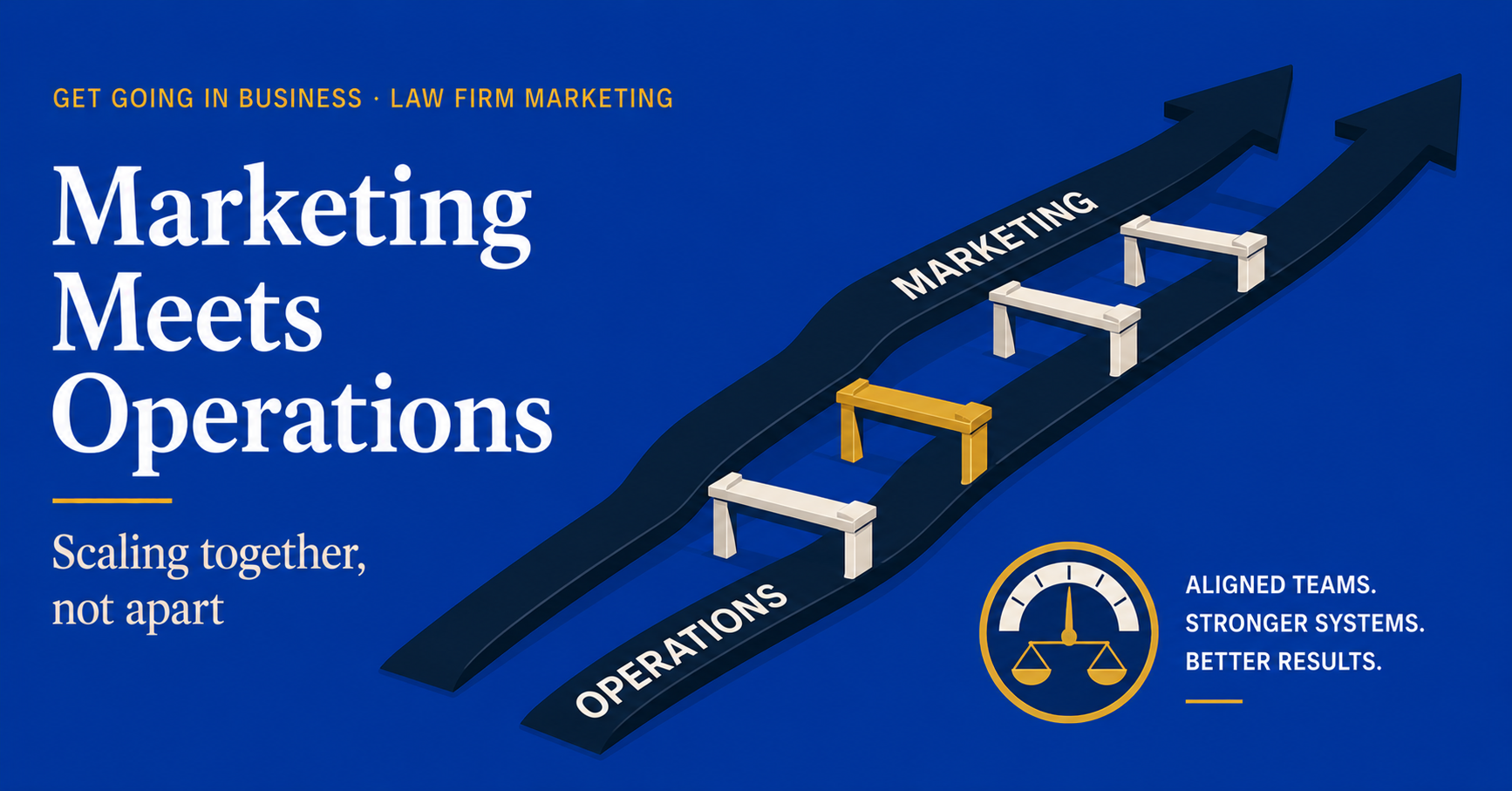
How to Get Your Law Firm’s Marketing and Operations Working Together

law firm marketing and operations alignment, closing the lead-volume capacity gap

There is a moment that happens at almost every growing law firm. Marketing is finally working. The pipeline is full. Leads are coming in faster than the firm can handle them. Consultations are getting booked four weeks out. Existing clients are waiting longer for updates. Attorneys are pulling 60-hour weeks. And the managing partner is staring at a marketing dashboard that says “more is better” while the operations team quietly drowns.


This is the marketing-operations gap. Marketing scales linearly with budget. Operations scales in steps, with hires and process changes. When the two grow at different rates, the firm hits a capacity wall. Every additional lead beyond that wall is wasted, every existing client suffers, and the firm’s reputation slowly erodes.


Law firm marketing and operations alignment is the discipline of keeping these two functions growing at compatible rates. Done right, it lets a firm scale smoothly. Done badly, it produces the worst kind of growth: visible to the outside, painful inside.


Why the Two Functions Grow at Different Rates

Marketing and operations have fundamentally different cost structures, which is why they get out of sync.


Marketing is mostly variable cost

Increase PPC spend by 30 percent and you get roughly 30 percent more leads, fast. The marginal cost of one more lead is roughly the same as the cost of the previous lead. You can scale marketing up and down in days, almost without limit.


Operations is mostly step-function cost

Going from 40 cases a month to 50 cases a month does not just cost 25 percent more. It often requires a new associate ($120,000 a year), a new paralegal ($60,000), or upgraded case management software. Operations capacity comes in chunks, and each chunk has a 3- to 6-month integration time.


The mismatch creates the gap

Marketing can add 30 percent more lead flow in a week. Operations cannot add 30 percent more case capacity in a week. The gap is where the alignment problem lives. When marketing outruns operations, every metric still looks good (more leads, more consultations) but the firm starts to break inside.


5 Signs You Have a Marketing-Operations Gap


Sign 1: Consultations are booked more than 2 weeks out

A healthy firm books consultations within 5 to 10 days. When you start booking 14 days out or more, demand is outrunning capacity. Some of those leads will not wait. They will book with a competitor whose calendar has space sooner. You are paying for leads to fund your competitor’s growth.


Sign 2: Existing client communication is slipping

Returned calls take longer. Email response times drift from same-day to 2 to 3 days. Case updates come less often. The intake team and the attorneys are spending their time on the front end (new leads, new consultations) at the cost of clients already on the books. Existing clients notice. Some of them leave reviews about it.


Sign 3: Quality of work is degrading

Filings get sloppier. Mistakes increase. Junior attorneys are doing work that used to go to senior attorneys. The firm is producing the same volume by lowering quality. Quality decline is the most expensive symptom because it shows up in case outcomes and reviews 3 to 6 months later, after the marketing budget has already done the damage.


Sign 4: Staff turnover is rising

People leave overworked firms. When marketing outpaces operations for more than two quarters, expect attrition. Each departure costs the firm 6 to 9 months of productivity and accelerates the gap because the remaining team is now doing more with less.


Sign 5: The managing partner is doing intake work or case work that should be delegated

This is the leading indicator. When the partner running the firm is fielding intake calls, drafting documents, or fixing operational issues that should be handled below them, the firm has hit its capacity ceiling. Continuing to scale marketing in this state makes everything worse, not better.

Marketing should only ever pull lead volume up to the level operations can absorb without quality decline. Past that point, marketing is destroying value, not creating it.


The Capacity Equation

Here is the simple version of the math that matters.

Maximum sustainable case volume = (Attorney hours available) ÷ (Hours per case) × (Quality factor)

Most firms can calculate the first two numbers but ignore the quality factor. A firm with 4 attorneys and 30 hours of available case-work time each per week has 480 hours per month. If average case requires 15 hours, theoretical capacity is 32 cases per month. The quality factor is usually 0.7 to 0.85 (accounting for sick days, training, client meetings, complications). Real sustainable capacity is 22 to 27 cases per month.


If marketing is delivering 35 qualified leads converting at 70 percent to consultation and 35 percent to retainer, that is 8 to 9 cases. Plenty of room. Scale marketing up.


If marketing is delivering 100 qualified leads converting at the same rates, that is 24 to 25 cases. You are at capacity. Adding more marketing budget will not produce more cases. It will produce more leads you cannot serve.


The Alignment Framework

Three structural changes keep marketing and operations growing at compatible rates.


Change 1: Capacity reviews before marketing budget reviews

Most firms set the marketing budget first and then ask operations to keep up. Reverse the order. Every quarter, review operations capacity first: hours available, current utilization, quality indicators. Then set marketing budget to match. If operations cannot absorb more, marketing budget holds steady (or shifts to channels with longer payoff cycles like SEO).


Change 2: Lead-to-capacity ratio as a shared metric

Track this monthly: (Qualified leads per month × Expected close rate) ÷ (Sustainable case capacity per month). Healthy ratio is 0.7 to 0.9. Above 1.0, you are over-capacity and burning leads. Below 0.5, you are under-utilizing capacity and underspending on marketing.


Both marketing and operations teams should see this number weekly. It is the single best early warning system for capacity drift.


Change 3: A standing monthly marketing-operations meeting

Sixty minutes a month. Marketing lead, operations lead, managing partner. One agenda:

  • Where is our lead-to-capacity ratio right now?
  • What’s our forecast for next month, marketing side and operations side?
  • Where are we likely to hit a constraint?
  • What’s the one move we’ll make this month?


Without this meeting, marketing optimizes for its own metrics and operations optimizes for its own metrics, and the firm pays for the mismatch in lost cases and burnt-out staff.


When to Slow Marketing, When to Scale Intake

Slow marketing when:

  • Lead-to-capacity ratio is above 1.0 for two consecutive months
  • Existing client satisfaction metrics are dropping (review scores, response times)
  • Staff turnover is above baseline
  • Quality indicators are declining (case outcomes, complications)


Scale intake before scaling marketing when:

  • Lead-to-consultation rate is below 40 percent (intake is the bottleneck)
  • Same-day callback rate is below 70 percent (capacity is the issue, not demand)
  • No-show rate is rising (intake quality, not volume, is the gap)


Scale marketing when:

  • Lead-to-capacity ratio is below 0.6 and trending stable
  • Operations team has capacity slack (above-baseline available hours)
  • Existing client metrics are healthy
  • Cost per signed client is profitable


The order matters. Scale intake first, prove the funnel works at higher volume, then turn marketing up. Scaling marketing first creates lead loss and reputation damage that takes 12 months to recover from.


The Connection to Everything Else

This is the final piece of the marketing operating system. The pillar of marketing organization, the audit of vendors, the alignment of intake and marketing, the dashboard and budget, the channel sequencing, the intake script. All of it depends on marketing and operations growing at compatible rates.


Without operations alignment, the rest is theater. You can audit your vendors perfectly and still drown the firm by scaling marketing past capacity. You can build the perfect intake script and still lose leads because consultation calendars are booked four weeks out. The alignment of marketing and operations is the discipline that lets every other improvement actually compound.


This is also why we keep coming back to the intake-marketing alignment problem. The two are deeply connected: intake is the bridge between marketing (volume) and operations (capacity). Get that bridge right and the whole system flows.


Frequently Asked Questions


Whose job is law firm marketing and operations alignment?

In firms below $3M in revenue, the managing partner. In firms $3M to $10M, the COO or operations director. Above $10M, a dedicated chief growth officer or director of revenue operations. Whoever it is, this is their primary job: keeping marketing and operations growing at compatible rates.


How often should we review the alignment?

Monthly at a minimum. Quarterly is too slow because capacity issues snowball within 60 to 90 days. Weekly is overkill for most firms unless you are in a fast-growth phase.


Can we just hire more people to keep up with marketing growth?

Sometimes, but hiring is a 3- to 6-month process before the new hire is fully productive. Marketing grows in weeks. If you wait until you need the hire to start hiring, you are already 4 months behind. Capacity planning should be 6 months ahead of marketing, not reactive to it.


What if our marketing is outside agencies and our operations is internal?

Same framework, harder execution. The outside agency does not naturally care about your operations capacity (they are not measured on it). The standing monthly meeting becomes more important. Include the agency. Share the lead-to-capacity ratio with them. The good agencies will adjust spend in response. The bad ones will keep pushing for more budget regardless. Their response tells you something.


Get Help Closing the Gap

If you have read all 12 articles in this series, you now have the full marketing operating system for a law firm: organized vendors, audited stack, working dashboard, healthy budget, aligned intake, sequenced channels, and now operations alignment. The pieces only work together when implemented as a system. We help law firms install the whole system in 90 days, not as a marketing project, but as an operations project that produces compounding results.


Want help building the bridge between your marketing and operations teams?


Book your free 15-min strategy call at getgoinginbusiness.com


Related: Why Your Law Firm’s Intake Team and Marketing Team Aren’t Aligned

Why Your Law Firm’s Intake Team and Marketing Team Aren’t Aligned

 law firm intake and marketing alignment, where the breakdown happens and how to fix it


Walk into most law firms and ask two questions. First, ask the marketing team: “How many leads did you produce last month?” Then ask the intake team: “How many leads did you receive last month?”


The numbers will not match. They almost never do.


Marketing will say 87. Intake will say 62. Marketing will pull up Google Ads dashboards. Intake will pull up the call log. Both will think the other team is wrong. Both will be partially right. And somewhere between those two numbers, 25 leads disappeared.


This is the most expensive and most ignored problem in law firms. Law firm intake and marketing alignment fails because the two teams measure different things, report to different people, and almost never sit in the same room. The leads do not fall through the cracks. They fall through the wall between the cracks.


Here is why it happens, where it costs you the most, and the 3-step framework to fix it.


Why the Two Teams Are Structurally Misaligned

The disconnect is not because anyone is bad at their job. It is because the two teams are built to optimize for different things.


Marketing optimizes for volume

A marketing agency or in-house team is measured on leads delivered. More clicks, more form fills, more calls. The agency dashboard shows volume. Their incentive is to grow the top of the funnel.


Intake optimizes for filtering

An intake team is measured on case quality and consultation rate. They are trained to politely turn away bad-fit cases, out-of-scope inquiries, and tire kickers. Their incentive is to protect the attorneys’ time.


Neither team is measured on the handoff between them

Here is the structural problem. Marketing’s job ends when the lead arrives. Intake’s job starts when the lead arrives. Nobody owns the gap between “lead arrived” and “lead answered.” That gap is where most leads die.


If you ask a marketing manager about a missed call, they will say “we delivered the lead.” If you ask an intake coordinator, they will say “we never got the call.” Both are technically correct. The lead is still gone.


Most law firms blame the marketing team for poor conversion and the intake team for missed leads. The actual problem is that no one owns the seam between them.


Where the Misalignment Shows Up

Five specific patterns repeat at almost every firm with a disconnected intake and marketing function.


Pattern 1: Marketing reports leads intake never saw

Your agency reports 87 conversions. Your intake log shows 62 inquiries. The 25-lead gap is form submissions that did not trigger an email notification, phone calls that went to voicemail outside of business hours, or contacts captured in a vendor system that never synced to your intake CRM. Each one is a real lead that nobody contacted.


Pattern 2: Intake reports calls marketing did not produce

The intake team logs 90 calls. Marketing claims credit for 87. The other 3 came from organic search, walk-ins, or referrals. Without source tagging, those 3 sources are invisible to marketing. The firm may be spending zero on the highest-ROI channel because no one is measuring it.


Pattern 3: Marketing targets the wrong cases

The intake team handles 50 leads. 38 are out-of-scope, out-of-jurisdiction, or below the firm’s case minimum. Intake is doing exactly what it was hired to do. Marketing has no idea this is happening, so the next campaign targets the same kind of leads, and the cycle repeats.


If marketing knew that 76 percent of leads from a specific campaign were unqualified, they would change targeting in a week. They never find out because intake’s only feedback to marketing is “please send more leads.”


Pattern 4: Intake feedback never reaches marketing

The intake coordinator notices that callers from one Google Ads campaign keep mentioning a service the firm does not offer. The coordinator tells the marketing manager in passing. The marketing manager forgets. The campaign keeps running for another four months.


Pattern 5: No shared definition of “qualified lead”

Marketing’s definition: someone who filled out the form or called the number. Intake’s definition: someone in our jurisdiction, with a matter we handle, ready to talk now. Until both teams agree on the definition, every report is comparing apples to oranges.


The 3-Step Framework to Fix It

Law firm intake and marketing alignment is not solved by hiring more people or buying more software. It is solved by three structural changes that take less than 30 days to implement.


Step 1: One shared definition of a qualified lead

Get marketing and intake in the same room for one hour. Define together what “qualified lead” means at your firm. Write it down. It typically looks like:

  • In our jurisdiction
  • Has a matter type we handle
  • Made contact in the last 48 hours
  • Has not been contacted by us already
  • Meets minimum case threshold (define what that is)

From this point forward, every report uses this definition. Marketing reports qualified leads, not conversions. Intake reports qualified leads, not total contacts. The numbers will start to converge within 60 days.


Step 2: Shared pipeline visibility

Both teams must see the same data. This usually means consolidating the lead intake into a single system, typically your CRM, and giving both marketing and intake login access.


Marketing sees what happens after the lead arrives: response time, consultation booked, retainer signed. Intake sees where the lead came from: PPC campaign, organic search, referral source. Both teams stop guessing.


This is where attribution and intake meet. We covered the full attribution chain (spend, leads, consultations, signed, case value) in our companion guide on tracking law firm marketing ROI. Shared pipeline visibility is what makes that chain visible to both teams instead of just to marketing.


Step 3: One weekly meeting

Thirty minutes a week. Marketing manager and intake lead. One agenda:

  • How many qualified leads came in last week?
  • How many were contacted within 15 minutes?
  • How many booked consultations?
  • What’s working and what isn’t?
  • What’s one thing we’ll change this week?

That meeting is the single highest-leverage change a law firm can make to its marketing function. It costs nothing. It takes 30 minutes. Most firms have never had it.


Who Should Own This Alignment

This is the question most firms avoid. Marketing reports to one person, intake reports to another, and neither one owns the seam. To fix the alignment, someone has to own the whole funnel from ad click to signed retainer.


In firms below $3M in revenue, this is usually the managing partner. They do not need to run marketing or intake day-to-day. They need to hold the weekly meeting and protect the shared definition of a qualified lead.


In firms above $3M, this is usually a COO, operations manager, or director of growth. Someone whose job is the funnel, not a piece of it.


In firms above $10M, this is often a dedicated growth or revenue operations role. The title varies. The function is the same: own the seam.


Whoever owns it, the rule is the same. Marketing reports to them. Intake reports to them. The weekly meeting is run by them. Without an owner, alignment slides back within 60 days every time.


What Changes When Alignment Works

Firms that fix intake and marketing alignment see three predictable changes within 90 days.


Lead-to-consultation rate goes up by 30 to 50 percent

Most of this comes from response time. When intake knows leads are coming in real time, calls get answered within 15 minutes instead of 4 hours. Speed is the single biggest predictor of booking rate.


Cost per signed client drops by 20 to 40 percent

Same marketing spend, more signed clients. The math improves because you stop losing leads in the gap. No new spend required.


Marketing decisions get faster

With intake feedback flowing into marketing weekly, campaigns get adjusted before bad targeting wastes a month of spend. The agency stops running blind. The firm stops paying for misfires.


Frequently Asked Questions


My intake team is just one person. Do we still need alignment meetings?

Yes, especially then. With one person doing intake, the alignment conversation is even more important because everything depends on that person’s bandwidth and feedback. Make the meeting weekly, keep it to 20 minutes if that fits, but do not skip it.


What if our marketing is an outside agency, not in-house?

The agency joins the weekly meeting. If they refuse, that is a different problem. A good agency wants intake feedback because it makes their work better. A bad agency wants distance because feedback makes them accountable.


Should marketing and intake share bonuses or KPIs?

Eventually, yes. The simplest version is a shared metric: signed clients per dollar of marketing spend, calculated monthly. Both teams move the needle on it. Both teams get credit when it improves. Both teams own the problem when it does not.


How long does this take to actually fix?

The structural changes (definitions, shared pipeline, weekly meeting) take 30 days to set up. The behavioral change (the teams trusting each other and acting on shared data) takes 60 to 90 days. The full payoff in conversion rates shows up in the second quarter, not the first month.


Get Help Closing the Intake-Marketing Gap

If your marketing reports and your intake reports do not agree, the issue is not which one is right. The issue is the seam between them. We help law firms install the three-step framework: shared definition, shared pipeline, weekly meeting. Most firms see measurable improvements in conversion rates within 60 days.


Want help aligning your intake team and your marketing team?


Book your free 15-min strategy call at getgoinginbusiness.com


Related: How to Track ROI on Every Marketing Dollar Your Law Firm Spends

Law Firm Intake and Marketing Alignment: Why the Disconnect Is Costing You Signed Clients


Law firm intake and marketing alignment — why the disconnect is costing you signed clients


Your marketing is generating leads. Your intake team is working those leads. But between the ad click and the signed retainer, something is getting lost. You can feel it — the numbers don’t add up — but you can’t pinpoint where.


In most law firms, the answer is a structural disconnect between the marketing function and the intake function. They are working toward related goals but operating with different information, different metrics, and no shared system for understanding what’s working.


Here’s what that disconnect looks like in practice — and the three-step framework to fix it.


What the Disconnect Looks Like


Your marketing agency runs campaigns. They report on impressions, clicks, and lead volume. They celebrate when leads go up.


Your intake team receives those leads. They follow up, handle calls, book consultations. They get frustrated when leads don’t convert or are poor quality.


Neither side has full visibility into the other’s world. Your agency doesn’t know that 60% of their leads are asking about a practice area you don’t prioritize. Your intake team doesn’t know that the ad campaign changed last week and leads are now coming in with different expectations.


The result: your agency optimizes for volume, your intake team drowns in unqualified leads, and your signed case number stays flat even as your marketing spend increases.


The most expensive version of this problem is when you increase your marketing budget to solve what is actually an intake problem. You get more leads. They convert at the same low rate. You blame the marketing.


Step 1: Agree on What a Qualified Lead Looks Like


Before your marketing agency can optimize toward the right outcome, both sides need to agree on what ‘good’ looks like. A qualified lead for your firm is not just someone who filled out a form — it is someone with a specific type of problem, in your geographic area, with a realistic ability to retain your services.


Schedule a meeting with your marketing team and your intake coordinator. Define your ideal client profile. Describe the leads that convert and the ones that don’t. Share actual examples. This conversation alone will change how your agency writes ad copy and targets audiences.


Action: Create a one-page qualified lead definition. Share it with your agency. Review it quarterly.


Step 2: Give Your Agency Visibility Into Conversion Data


Most marketing agencies only see the top of the funnel — traffic, clicks, form fills, calls. They don’t see what happens after the lead arrives. They don’t know which campaigns are producing retained clients versus window shoppers.


When you share conversion data — consultation rate by source, retained rate by source, average case value by source — your agency can optimize for what actually matters to your business. Without that data, they are flying blind and optimizing for the wrong thing.


Action: Connect your CRM to your marketing reporting. At minimum, add a lead source field to every new contact in your CRM and track it through to retained or closed. Share a monthly conversion report with your agency.


Step 3: Build a Shared Pipeline View


The intake team and the marketing team should be looking at the same pipeline. Not separate reports — the same live dashboard showing leads by source, status, and conversion rate.


When both teams see the same data, conversations change. Instead of the agency reporting on clicks and the intake team reporting on consultations, both teams are looking at the same conversion funnel and asking the same question: where are leads dropping off, and what do we do about it?


Action: Configure your CRM to show a pipeline view that both teams can access. Hold a monthly joint review where marketing and intake sit down together and walk through the funnel.


What Changes When You Fix the Alignment


When intake and marketing are aligned, several things shift:

  • Your agency targets better leads because they know what converts
  • Your intake team has more context about where leads are coming from and what they expect
  • You can see exactly which marketing channels are producing signed cases — not just leads
  • Both teams are accountable to the same outcome: retained clients, not just lead volume


Intake and marketing alignment is not a meeting. It is a system. Shared data, shared definitions, and shared accountability produce results that neither team can achieve working separately. 


Ready to align your intake and marketing teams around the same goal?

Book your free 15-min strategy call at getgoinginbusiness.com


Related: How to Organize Your Law Firm’s Marketing Vendors & Stop Wasting Money →