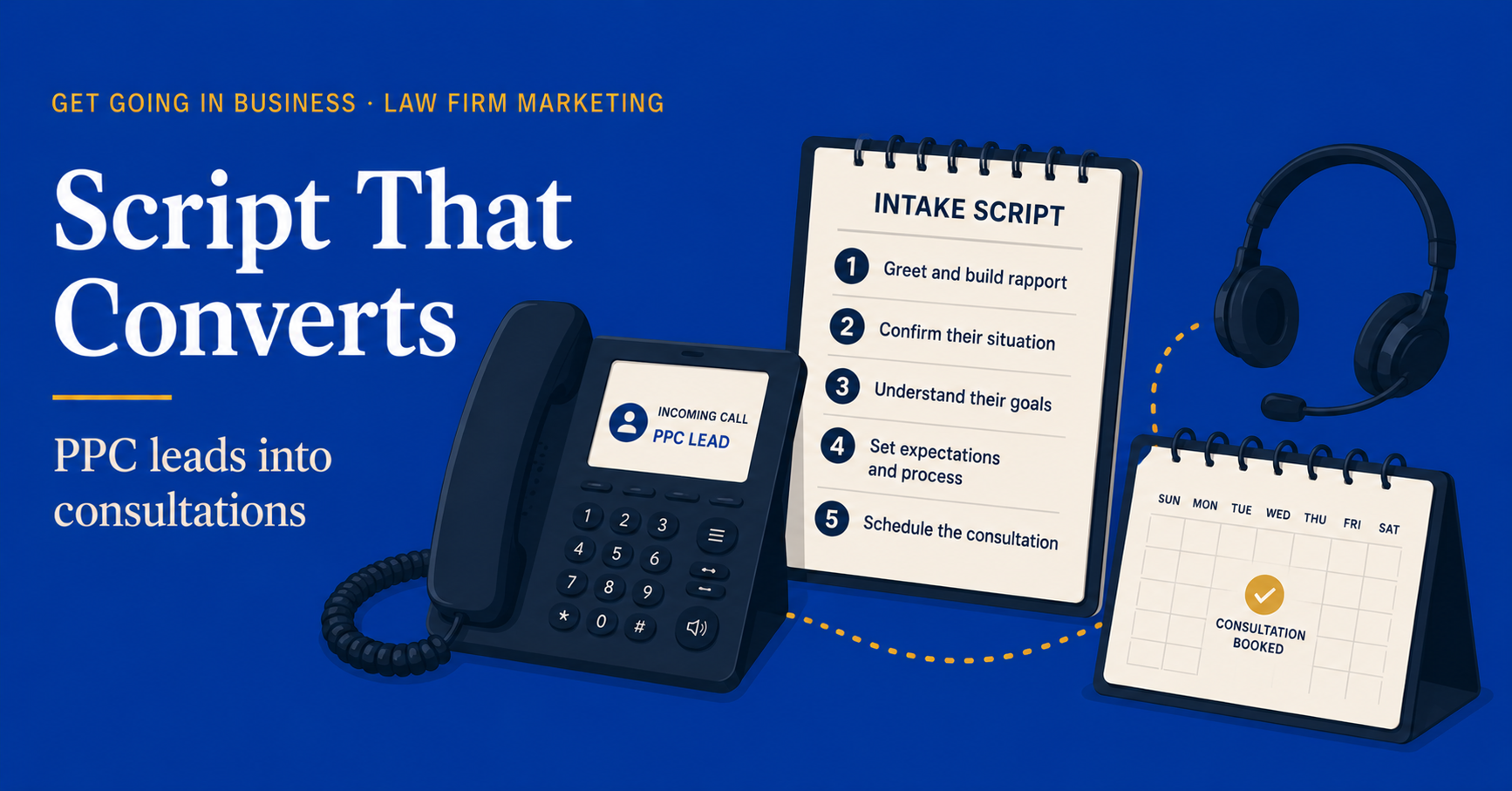
The Law Firm Intake Script That Converts PPC Leads Into Consultations

legal intake script for PPC leads, 5-part script that converts paid leads


PPC leads are not the same as referral leads. A referral arrives warm: someone they trust has already vouched for you. They are calling to schedule, not to evaluate. A PPC lead arrives cold: they clicked your ad 90 seconds ago, they have your competitor’s tab still open in their browser, and they will be off the phone in 12 minutes either way. Your intake team has one shot.


Most law firms use the same intake script for both. That is why their PPC leads convert at half the rate of their referral leads. Same training, same script, completely different conversation. A proper legal intake script for PPC leads acknowledges what makes paid leads different and adapts the conversation accordingly.


Here is the 5-part script that converts. Built specifically for paid leads. Trainable in one sitting.


Why PPC Leads Behave Differently

Three things make paid leads harder to convert than referral leads. The script handles each one.


They are comparison shopping in real time

Someone searching “divorce attorney Richmond” right now is looking at five law firms in the same 10-minute window. They will call two or three of them. The firm that handles the call best wins the consultation. The other firms get a voicemail and a callback that does not happen.


They have lower commitment levels

Referral leads have already decided they need a lawyer. PPC leads are often still figuring out whether they even need one. “Maybe I can handle this myself.” “Maybe I should wait.” “Maybe my friend was wrong.” Your intake person is selling the consultation, not the firm.


They have shorter attention windows

Average PPC lead phone call: 8 to 14 minutes. Average referral lead phone call: 18 to 30 minutes. You have roughly half the time to book the consultation. The script has to be efficient or the call ends before you have closed.


The 5-Part Script

Each part has a specific job. Skip any one of them and conversion drops. Here is the full structure, with example language for a family law firm. Adapt the wording to your practice area, but keep the structure.


Part 1: Open with confidence and confirm the right place

First 10 seconds. Goal: signal competence and confirm fit.

Example: “Good morning, thanks for calling [Firm Name], this is Sarah. Are you looking for help with a family law matter today?”

Why this works: it confirms the caller reached the right firm, signals a warm professional tone, and immediately establishes that the firm handles the matter. Most intake openings are vague (“how can I help you?”). Specific is better than open.


Part 2: Acknowledge and qualify with one question

Next 60 seconds. Goal: make the caller feel heard while quickly establishing whether they are a fit.


Example: “I’m sorry you’re going through this. Before I connect you with one of our attorneys, can I ask, are you currently in Virginia, and is this a matter that’s already been filed in court, or are you trying to figure out your next step?”


Why this works: empathy first, qualification second. The two-part question (jurisdiction + filing status) handles 80 percent of disqualification cases without making the caller feel interrogated. Out-of-jurisdiction callers self-eliminate. Tire kickers usually reveal themselves in the answer.


Part 3: Position the consultation as the next obvious step

Minutes 2 to 4. Goal: take the consultation from a maybe to a yes by making it the natural action.


Example: “That helps me understand. What we typically do at this point is set you up with a 30-minute consultation with one of our attorneys. They’ll walk you through your options, what filing would look like, and whether you even need to file. There’s no obligation after that. We have openings this Thursday at 2 or Friday at 10, which works better?”


Why this works: it does not ask “would you like to book a consultation?” It assumes the consultation. It also gives a binary choice (Thursday or Friday), which is far more likely to close than an open question (“when works for you?”). The mention of “no obligation after that” defuses the buying resistance specific to cold leads.


Part 4: Handle the price question if it comes up

Optional, but happens on 40 percent of PPC calls. Goal: neutralize the price question without losing the consultation.


Example: “That’s a great question. Our consultation fee is $150, and we apply that fee to your retainer if you decide to work with us. The reason it’s not free is that our attorneys spend the full 30 minutes giving you specific legal advice, which is the same advice we’d be giving you as a client. Most people find it’s worth $150 to walk out knowing exactly where they stand. Do you want to lock in Thursday or Friday?”


Why this works: it answers the price question directly (do not dodge), justifies the price with a benefit, and immediately re-closes on the consultation. Most intake teams answer the price question and then go quiet. The script keeps the momentum.


Part 5: Confirm and set the next contact

Last 60 seconds of the call. Goal: lock in the booking and reduce no-shows.

Example: “Perfect, I have you down for Thursday at 2 PM with Attorney Williams. You’ll get a confirmation email in the next five minutes and a reminder text the morning of the consultation. If anything changes, just reply to that text and we’ll reschedule. Anything else I can answer right now?”


Why this works: it confirms specifics (day, time, attorney name), sets expectations for the next contact, and offers a low-friction way to reschedule. PPC leads no-show at higher rates than referral leads; the explicit confirmation step cuts no-shows by 30 to 40 percent.


The script is not magic. It just removes friction at every step where most intake conversations stall. Hesitation kills PPC bookings faster than anything else.


Common Objections and How to Handle Them

Objection: “I just have a quick question, I don’t think I need a consultation”

Response: “I totally understand. The thing is, most quick questions in family law have answers that depend on facts your situation has but I don’t know yet. The consultation is where you get an actual answer based on your specific facts. If after the consultation you decide you don’t need our help, that’s totally fine. Want to grab Thursday at 2?”


Objection: “Let me think about it and call back”

Response: “Of course. While we’re on the phone, can I tentatively hold a spot for you? That way if you decide to move forward, you don’t have to play phone tag. If you decide not to, just reply to the confirmation email and the slot opens back up. Thursday at 2 or Friday at 10?”


Objection: “How much will the whole case cost?”

Response: “That’s the most important question, and the honest answer is it depends on the complexity of your situation. The consultation is where the attorney can give you a realistic range based on your specifics. We don’t quote case fees on the phone because we don’t want to mislead you. Thursday at 2 works to get you that answer?”


Objection: “I’m calling around to compare”

Response: “That’s smart. Most people we work with talked to two or three firms first. What I’d suggest is doing the consultation with us, then deciding. The consultation gives you something concrete to compare, not just a phone impression. Thursday at 2?”


Training Your Team in One Sitting

This script is trainable in 90 minutes. Here is how to roll it out.


Minute 0 to 15: Walk through the structure

Read the full script with the team. Explain why each part exists. Take questions. Most intake people will push back on at least one piece (usually the assumed-close in Part 3). Hear them out, then ask them to try it the new way for 30 days before judging.


Minute 15 to 45: Role-play

Pair up. One person plays the caller, one plays the intake. Run through three scenarios: a clear-fit lead, an out-of-jurisdiction lead, and a tire-kicker who asks about price. Switch roles. Repeat.


Minute 45 to 75: Listen to actual calls

Pull three or four recent PPC call recordings. Listen as a team. Identify where the existing approach matched the new script, where it diverged, and what the diverging moments cost. Most teams find at least one moment per call where they accidentally killed momentum.


Minute 75 to 90: Commit to the rollout

Agree on the start date (usually the following Monday), the success metric (booked consultations per qualified lead), and the review cadence (weekly for the first month, then monthly). Print the script. Tape it to the intake desk.


What to Measure After the Rollout

Track these four metrics weekly for the first month, then monthly.

  • Booked consultation rate (consultations / qualified leads): should rise 20 to 40 percent within 30 days
  • Time on call (PPC leads only): should stay stable or drop; if it rises significantly, intake is straying from the script
  • No-show rate: should drop 20 to 40 percent in 30 days
  • Cost per booked consultation: should drop 25 to 35 percent within 30 days as more of the same leads convert

If you do not see movement in three of these four metrics within 30 days, the script is not being followed consistently. Listen to calls again, identify the drift, retrain.


Why This Connects to Marketing

A working intake script multiplies marketing budget. Same ad spend, more booked consultations, more signed retainers. We covered the full intake-marketing connection in our companion guide on law firm intake and marketing alignment, which goes deeper into how the two functions should report and meet together.


The script alone gets you 70 percent of the conversion improvement. The full alignment framework gets you the other 30 percent and makes the gains stick.


Frequently Asked Questions

Should I use the same script for SEO and referral leads?

No. SEO and referral leads have different psychology than PPC leads. Referral leads need less qualification and more relationship-building. SEO leads sit in between. Use this PPC script for paid leads, and a slightly different script for organic and referral leads. Most firms run two or three scripts in parallel.


How long until I see results from a new script?

Booked consultation rate usually moves within 14 days. No-show rate takes 30 days because you need a full cycle of bookings. Cost per signed client takes 60 to 90 days because retainer decisions lag.


What if my intake team refuses to use a script?

Reframe it as a framework, not a script. Most intake people resist memorized lines but accept structural guidance. Position it as “here is the order things should happen in” rather than “here is what to say word for word.” Comply with the structure, adapt the words to their voice.


Can a virtual receptionist service use this script?

Yes, and they should. Most virtual receptionist services will accept a custom script if you provide it. Have them practice the role-play scenarios in Section 4 before going live. Without the role-play, they will read the script flatly and conversion will not improve.


Get Help Implementing the Script

If your PPC leads are converting at less than half the rate of your referral leads, your intake script is the highest-leverage change you can make. We help law firms adapt this script to their practice area, train the intake team, and measure the rollout. Most firms see measurable conversion improvement within 30 days.


Want help training your intake team on a PPC-specific script?


Book your free 15-min strategy call at getgoinginbusiness.com


Related: Why Your Law Firm’s Intake Team and Marketing Team Aren’t Aligned

Why Your Law Firm’s Intake Team and Marketing Team Aren’t Aligned

 law firm intake and marketing alignment, where the breakdown happens and how to fix it


Walk into most law firms and ask two questions. First, ask the marketing team: “How many leads did you produce last month?” Then ask the intake team: “How many leads did you receive last month?”


The numbers will not match. They almost never do.


Marketing will say 87. Intake will say 62. Marketing will pull up Google Ads dashboards. Intake will pull up the call log. Both will think the other team is wrong. Both will be partially right. And somewhere between those two numbers, 25 leads disappeared.


This is the most expensive and most ignored problem in law firms. Law firm intake and marketing alignment fails because the two teams measure different things, report to different people, and almost never sit in the same room. The leads do not fall through the cracks. They fall through the wall between the cracks.


Here is why it happens, where it costs you the most, and the 3-step framework to fix it.


Why the Two Teams Are Structurally Misaligned

The disconnect is not because anyone is bad at their job. It is because the two teams are built to optimize for different things.


Marketing optimizes for volume

A marketing agency or in-house team is measured on leads delivered. More clicks, more form fills, more calls. The agency dashboard shows volume. Their incentive is to grow the top of the funnel.


Intake optimizes for filtering

An intake team is measured on case quality and consultation rate. They are trained to politely turn away bad-fit cases, out-of-scope inquiries, and tire kickers. Their incentive is to protect the attorneys’ time.


Neither team is measured on the handoff between them

Here is the structural problem. Marketing’s job ends when the lead arrives. Intake’s job starts when the lead arrives. Nobody owns the gap between “lead arrived” and “lead answered.” That gap is where most leads die.


If you ask a marketing manager about a missed call, they will say “we delivered the lead.” If you ask an intake coordinator, they will say “we never got the call.” Both are technically correct. The lead is still gone.


Most law firms blame the marketing team for poor conversion and the intake team for missed leads. The actual problem is that no one owns the seam between them.


Where the Misalignment Shows Up

Five specific patterns repeat at almost every firm with a disconnected intake and marketing function.


Pattern 1: Marketing reports leads intake never saw

Your agency reports 87 conversions. Your intake log shows 62 inquiries. The 25-lead gap is form submissions that did not trigger an email notification, phone calls that went to voicemail outside of business hours, or contacts captured in a vendor system that never synced to your intake CRM. Each one is a real lead that nobody contacted.


Pattern 2: Intake reports calls marketing did not produce

The intake team logs 90 calls. Marketing claims credit for 87. The other 3 came from organic search, walk-ins, or referrals. Without source tagging, those 3 sources are invisible to marketing. The firm may be spending zero on the highest-ROI channel because no one is measuring it.


Pattern 3: Marketing targets the wrong cases

The intake team handles 50 leads. 38 are out-of-scope, out-of-jurisdiction, or below the firm’s case minimum. Intake is doing exactly what it was hired to do. Marketing has no idea this is happening, so the next campaign targets the same kind of leads, and the cycle repeats.


If marketing knew that 76 percent of leads from a specific campaign were unqualified, they would change targeting in a week. They never find out because intake’s only feedback to marketing is “please send more leads.”


Pattern 4: Intake feedback never reaches marketing

The intake coordinator notices that callers from one Google Ads campaign keep mentioning a service the firm does not offer. The coordinator tells the marketing manager in passing. The marketing manager forgets. The campaign keeps running for another four months.


Pattern 5: No shared definition of “qualified lead”

Marketing’s definition: someone who filled out the form or called the number. Intake’s definition: someone in our jurisdiction, with a matter we handle, ready to talk now. Until both teams agree on the definition, every report is comparing apples to oranges.


The 3-Step Framework to Fix It

Law firm intake and marketing alignment is not solved by hiring more people or buying more software. It is solved by three structural changes that take less than 30 days to implement.


Step 1: One shared definition of a qualified lead

Get marketing and intake in the same room for one hour. Define together what “qualified lead” means at your firm. Write it down. It typically looks like:

  • In our jurisdiction
  • Has a matter type we handle
  • Made contact in the last 48 hours
  • Has not been contacted by us already
  • Meets minimum case threshold (define what that is)

From this point forward, every report uses this definition. Marketing reports qualified leads, not conversions. Intake reports qualified leads, not total contacts. The numbers will start to converge within 60 days.


Step 2: Shared pipeline visibility

Both teams must see the same data. This usually means consolidating the lead intake into a single system, typically your CRM, and giving both marketing and intake login access.


Marketing sees what happens after the lead arrives: response time, consultation booked, retainer signed. Intake sees where the lead came from: PPC campaign, organic search, referral source. Both teams stop guessing.


This is where attribution and intake meet. We covered the full attribution chain (spend, leads, consultations, signed, case value) in our companion guide on tracking law firm marketing ROI. Shared pipeline visibility is what makes that chain visible to both teams instead of just to marketing.


Step 3: One weekly meeting

Thirty minutes a week. Marketing manager and intake lead. One agenda:

  • How many qualified leads came in last week?
  • How many were contacted within 15 minutes?
  • How many booked consultations?
  • What’s working and what isn’t?
  • What’s one thing we’ll change this week?

That meeting is the single highest-leverage change a law firm can make to its marketing function. It costs nothing. It takes 30 minutes. Most firms have never had it.


Who Should Own This Alignment

This is the question most firms avoid. Marketing reports to one person, intake reports to another, and neither one owns the seam. To fix the alignment, someone has to own the whole funnel from ad click to signed retainer.


In firms below $3M in revenue, this is usually the managing partner. They do not need to run marketing or intake day-to-day. They need to hold the weekly meeting and protect the shared definition of a qualified lead.


In firms above $3M, this is usually a COO, operations manager, or director of growth. Someone whose job is the funnel, not a piece of it.


In firms above $10M, this is often a dedicated growth or revenue operations role. The title varies. The function is the same: own the seam.


Whoever owns it, the rule is the same. Marketing reports to them. Intake reports to them. The weekly meeting is run by them. Without an owner, alignment slides back within 60 days every time.


What Changes When Alignment Works

Firms that fix intake and marketing alignment see three predictable changes within 90 days.


Lead-to-consultation rate goes up by 30 to 50 percent

Most of this comes from response time. When intake knows leads are coming in real time, calls get answered within 15 minutes instead of 4 hours. Speed is the single biggest predictor of booking rate.


Cost per signed client drops by 20 to 40 percent

Same marketing spend, more signed clients. The math improves because you stop losing leads in the gap. No new spend required.


Marketing decisions get faster

With intake feedback flowing into marketing weekly, campaigns get adjusted before bad targeting wastes a month of spend. The agency stops running blind. The firm stops paying for misfires.


Frequently Asked Questions


My intake team is just one person. Do we still need alignment meetings?

Yes, especially then. With one person doing intake, the alignment conversation is even more important because everything depends on that person’s bandwidth and feedback. Make the meeting weekly, keep it to 20 minutes if that fits, but do not skip it.


What if our marketing is an outside agency, not in-house?

The agency joins the weekly meeting. If they refuse, that is a different problem. A good agency wants intake feedback because it makes their work better. A bad agency wants distance because feedback makes them accountable.


Should marketing and intake share bonuses or KPIs?

Eventually, yes. The simplest version is a shared metric: signed clients per dollar of marketing spend, calculated monthly. Both teams move the needle on it. Both teams get credit when it improves. Both teams own the problem when it does not.


How long does this take to actually fix?

The structural changes (definitions, shared pipeline, weekly meeting) take 30 days to set up. The behavioral change (the teams trusting each other and acting on shared data) takes 60 to 90 days. The full payoff in conversion rates shows up in the second quarter, not the first month.


Get Help Closing the Intake-Marketing Gap

If your marketing reports and your intake reports do not agree, the issue is not which one is right. The issue is the seam between them. We help law firms install the three-step framework: shared definition, shared pipeline, weekly meeting. Most firms see measurable improvements in conversion rates within 60 days.


Want help aligning your intake team and your marketing team?


Book your free 15-min strategy call at getgoinginbusiness.com


Related: How to Track ROI on Every Marketing Dollar Your Law Firm Spends

Attorney Intake Process Best Practices: What High-Converting Law Firms Do Differently

Attorney Intake Process Best Practices - High Converting Law Firms


Most law firms compete on expertise, reputation, and marketing. The firms that grow the fastest compete on something different: speed and consistency of their intake process.


The difference between a law firm with a full calendar and one constantly chasing new leads is rarely the quality of the legal work. It’s what happens in the first 24 hours after a new lead comes in. Here are the intake process best practices that separate high-converting firms from those that wonder why their marketing isn’t working.


48%

of law firms are essentially unreachable by phone or email

21×

more conversations when you respond within 5 minutes

67%

of clients hire the first attorney who responds


1. Respond Within Five Minutes During Business Hours

This is the single most impactful thing you can do to improve your intake conversion rate. Studies show that firms responding within five minutes are 21 times more likely to have a meaningful conversation with a lead than those responding after 30 minutes.


Most law firms respond within 24 hours — if they respond at all. The firms that respond within five minutes during business hours operate in an entirely different category. They close more clients from the same number of leads, which means every marketing dollar goes further.


How to implement: Set up automated immediate acknowledgement (email or text) the moment a lead submits a form or calls. Then have a live person follow up within five minutes during business hours. Use a CRM with lead notifications that alert the intake coordinator instantly.


2. Automate the First Acknowledgement

Even if you cannot have a human respond in five minutes every time, an automated acknowledgement changes the lead’s experience immediately. A simple message — ‘We received your inquiry and someone will be in touch within the hour’ — tells the lead they are not in a black hole and buys you time.


Firms that send nothing leave leads wondering whether the form worked, whether anyone saw it, and whether they should call someone else. Many do.


How to implement: Set up an automated email or text response in your CRM or website form tool. Keep it simple, warm, and specific about when they can expect to hear from a real person.


3. Have a Script for the First Contact


The first live conversation with a new lead is not the time to improvise. High-converting intake processes use a consistent script or framework that covers: acknowledging the inquiry, qualifying the lead quickly, establishing credibility, setting expectations for the next step, and booking the consultation before ending the call.


Without a script, intake conversations meander. They either go too long and waste time on leads who will never convert, or they end without a clear next step — which means the lead drifts away.


How to implement: Write a simple framework — not a word-for-word script — for your intake coordinator. Train it. Role play it. Review calls regularly to identify where conversations are going off track.


4. Follow Up at Least Three Times


Most law firms make one follow-up attempt and stop. Most conversions happen after two to five attempts. The math on this is straightforward: if you stop at one attempt and your competitor follows up three times, they will sign clients you generated.


The sequence matters as much as the frequency. A same-day call, a same-day email if no answer, and a follow-up call the next morning covers the window where most leads are still actively looking.


How to implement: Build a defined follow-up sequence into your CRM. Automate the email steps. Make the call attempts a daily task item for your intake coordinator with a visible pipeline view.


5. Make Booking a Consultation Frictionless

If a lead has to email back and forth three times to find a time to speak with an attorney, a percentage of them will not bother. Every additional step between ‘interested’ and ‘consultation booked’ reduces your conversion rate.


High-converting firms send a direct scheduling link — either in the automated acknowledgement or during the first call. The lead picks a time, gets a confirmation, and receives a reminder. The entire process takes under two minutes.


How to implement: Use a scheduling tool like Calendly, Acuity, or your CRM’s built-in scheduling. Embed it in your website and include the link in your intake email sequence.


6. Collect Information Before the Consultation


Attorneys who walk into a consultation blind spend the first ten minutes gathering basic information they could have had in advance. This makes the consultation feel generic and wastes time that should be spent on legal strategy and relationship building.


A short intake form — completed before the consultation — focuses the conversation and signals professionalism. It also helps qualify leads before the consultation, so attorneys are not spending time on cases that are not a fit.


How to implement: Send a brief digital intake form immediately after a consultation is booked. Keep it to five to ten questions. Use a tool that integrates with your CRM so the information is in the file before the attorney walks in.


7. Send a Follow-Up After Every Consultation

A significant percentage of potential clients who complete a consultation do not sign immediately. They are comparing options, thinking it over, or waiting on a financial decision. Firms that send a follow-up within 24 hours — summarizing what was discussed and outlining the next step — convert a meaningful portion of these delayed decisions.


Firms that do nothing after the consultation leave the decision entirely to the lead, with no additional touchpoint to tip the balance.


How to implement: Build a post-consultation email template. Personalize it with the specific issue discussed and the recommended next step. Send it within 24 hours. If there is no response after three days, follow up again.


The firms that convert the most leads are not the ones with the best attorneys or the biggest marketing budgets. They are the ones who follow attorney intake process best practices consistently. Consistency is a system, not a personality trait


Want to see where your intake process is losing clients?

Book your free 15-min strategy call at getgoinginbusiness.com


Related: How to Organize Your Law Firm’s Marketing Vendors & Stop Wasting Money →

Why Your Law Firm’s Intake Team Isn’t Following Up (It’s Not What You Think)

Why Your Law Firm's Intake Team Isn't Following Up


You check the CRM on a Monday morning and see five new leads from the weekend. You scroll down. None of them have been contacted. You ask your intake coordinator what happened. They say they’ve been busy. You remind them — again — that speed matters. Things improve for a week. Then it happens again.


If this sounds familiar, here’s the hard truth: the problem probably isn’t your intake coordinator.


In most law firms, when follow-up falls through the cracks, it’s not because the person responsible doesn’t care or isn’t trying. It’s because the system they’re working in makes it almost impossible to follow up consistently. Before you have another conversation about accountability, check whether any of the five issues below are present in your firm.


The most expensive leads aren’t the ones you never got. They’re the ones that came in, sat in an inbox for 24 hours, and called someone else.


Reason 1: There Is No Clear Owner for Lead Follow-Up


In many law firms, leads arrive through multiple channels — the website form, a phone call, a legal directory, a referral email — and nobody has explicitly agreed on who is responsible for each one. The assumption is that someone will handle it. But ‘someone’ is not a system.


When a lead comes in through the website form at 4:47pm on a Friday, does your intake coordinator know it’s their responsibility? Does the front desk? Does the attorney’s assistant? If the answer is ‘it depends’ or ‘usually the coordinator,’ you have an ownership gap — and ownership gaps produce missed follow-ups every single time.


The fix: Define one owner for every lead source. Write it down. Make it part of onboarding. Every lead that comes in through [source] is owned by [person] and must be contacted within [timeframe].


Reason 2: The Lead Came In But Nobody Knew


This one is more common than most firm owners realize. A lead submits a form on your website. The form sends an email notification to a general inbox — info@yourfirm.com or the attorney’s personal email. That email sits unread among 200 others. Nobody follows up because nobody saw the lead.


Or the lead calls, gets voicemail, leaves a message — and the voicemail notification goes to a phone that three people share, and all three assume one of the others will handle it.


The tool is technically working. The notification is technically being sent. But the lead is functionally invisible to the person who needs to act on it.


The fix: Every lead source needs to route into one place — your CRM — with a notification that goes to a specific person, not a shared inbox. If you don’t have a CRM, this problem will keep recurring regardless of how many conversations you have about follow-up.


Reason 3: There Is No Follow-Up Process After the First Attempt


Even firms that respond quickly to the first inquiry often have no system for what happens if the lead doesn’t respond. The coordinator calls. No answer. Leaves a voicemail. And then waits.


In most cases, that lead is effectively dead — not because the person isn’t interested, but because nobody made a second or third attempt. Research consistently shows that most leads require between two and five contact attempts before they respond. If your process stops at one, you’re leaving a significant percentage of your pipeline on the table.


The fix: Build a defined follow-up sequence. Attempt 1: call within the first hour. Attempt 2: email the same day if no answer. Attempt 3: call again the next morning. After three attempts with no response, move to a nurture sequence. This sequence should be documented, trained, and automated where possible.


Reason 4: The Intake Coordinator Is Overwhelmed With Other Tasks


In many small and mid-size law firms, the person responsible for intake is also answering phones, managing the attorney’s calendar, processing mail, handling billing questions, and doing a dozen other things. Lead follow-up is on their list — but it’s competing with everything else, and the urgent always beats the important.


When a new lead comes in during a busy stretch, the coordinator tells themselves they’ll get to it after the current task. An hour passes. Then two. By the time they reach out, the lead has already called two other firms.


The fix: Intake follow-up needs to be treated as a protected task, not a background responsibility. Set dedicated blocks in the day — morning and afternoon — where the sole focus is working the lead pipeline. During those blocks, nothing else gets prioritized.


Reason 5: There Is No Way to See What’s Falling Through


This is the most systemic reason and the hardest to fix without the right tools. If you have no visibility into your lead pipeline — no dashboard showing which leads have been contacted, which are waiting, which have been attempted multiple times — then you cannot manage what you cannot see.


Your intake coordinator may be doing their best within a system, but without an organized law firm marketing system behind them, they’re working from memory, email threads, and sticky notes. In that environment, things will fall through the cracks no matter how diligent the person is.


The fix: A CRM is not optional — it’s the foundation. Every lead needs to be in the system with a status, a contact history, and a next action. If your coordinator can see at a glance which leads need attention today, follow-up rates improve dramatically. If they can’t, they’re guessing.


What to Do First


If any of the five reasons above resonated, don’t try to fix everything at once. Start here:

  1. Audit your lead sources — list every place a new lead can come from and confirm there is a named owner for each one
  2. Check your CRM — if leads are not being logged in a central system, that is your first priority
  3. Document your follow-up sequence — write down exactly what should happen after a lead comes in, step by step, with time targets
  4. Protect intake time — block time in your coordinator’s calendar specifically for working the pipeline


Most follow-up failures are not people problems. They are process problems. Fix the system and the results will follow.


Is your intake process losing leads you should be closing?

Book your free 15-min strategy call at getgoinginbusiness.com


Related: How to Organize Your Law Firm’s Marketing Vendors and Stop Wasting Money