Most law firms keep their marketing agency too long. Not because the relationship is working, but because firing them feels harder than tolerating them. The contract is sticky. The agency has all the account logins. Switching means starting over. So another month goes by, another retainer gets paid, and the firm signs fewer cases than it should.
Knowing how to fire your law firm marketing agency is half decision, half logistics. The decision is straightforward once you stop avoiding it. The logistics matter more than most firms realize, because a bad off-boarding can lose you data, ad accounts, leads in transit, and 60 days of momentum.
This guide covers the seven real signs the relationship is over, the three signs that look like failure but aren’t, and the off-boarding checklist that protects your firm on the way out.
7 Clear Signs the Agency Has Failed
If three or more of these are true, the agency is not coming back from this. Make the call.
Sign 1: They cannot tell you cost per signed client
Ask them: “What did we pay per signed retainer in the last 90 days?” If they cannot answer in five minutes, they are tracking the wrong metric. Cost per click, cost per conversion, click-through rate. None of those tell you whether the agency is profitable for your firm. A good agency knows your cost per signed client because they have integrated with your CRM. A failing agency deflects to vanity metrics every time you ask.
Sign 2: Reports look great, signed cases don’t match
Every monthly report shows green arrows and improvement charts. Meanwhile, your firm has signed the same number of cases for six straight months. The agency is reporting on platform metrics, not business metrics. That gap is the gap between a working PPC agency and a broken one.
Sign 3: They refuse to give you full account access
You should have admin access to your own Google Ads account, your Google Business Profile, your website, your CRM, and any other platform the agency manages on your behalf. If they require you to go through them for any of these, you are not the owner of your own marketing. You are a tenant. Fire them.
Sign 4: They blame your intake every time numbers slip
Sometimes intake really is the problem. A good agency works with intake to fix it. A bad agency uses intake as a permanent excuse. If every quarterly review ends with “your intake needs work,” but the agency has never offered to help fix it, they are not your partner. They are a vendor pointing at another vendor.
Sign 5: Same campaign, same keywords, same creative for 6+ months
Marketing requires constant iteration. Ad copy gets stale. Keywords get more competitive. Landing pages need refreshing. If you log into your account and see the same ads running unchanged for half a year, the agency is collecting a retainer without doing the work.
Sign 6: They are slow to respond and slower to act
Send an email asking for a small change: pause a campaign, add a negative keyword, update a landing page headline. How long does it take to happen? A good agency executes inside 48 hours. A failing agency takes a week, two weeks, or never gets to it. The lag tells you where you are on their priority list.
Sign 7: You dread the monthly call
This one is the most subjective and often the most accurate. If you have started skipping the monthly call, scheduling around it, or letting your marketing manager handle it because you cannot stand another hour of “impressions are up,” your gut already knows. Trust it.
Pattern matters more than any single sign. One of these in isolation might be a bad month. Three or more, sustained for 90 days, is a failed relationship.
3 Signs That Look Like Failure but Aren’t
Sometimes the agency is actually fine and the issue is elsewhere. Before you fire them, rule these out.
Looks like failure 1: Leads are up, signed cases are flat
If the agency is delivering more qualified leads but your firm is not converting them, the bottleneck is your intake or your closing process. A new agency will not fix this. They will just deliver the same leads to the same broken funnel.
Looks like failure 2: Cost per click went up
CPC inflation happens to everyone. Competitors enter the market. Google raises base prices. If your CPC went up but your cost per signed client stayed flat, the agency is doing its job and absorbing market shifts. That is good performance, not bad.
Looks like failure 3: One bad month after several good ones
Marketing is volatile. A single down month can be statistical noise, a seasonal dip, or a Google algorithm change. Do not fire over one month. Look at the 90-day trend. If it is still healthy, hold steady.
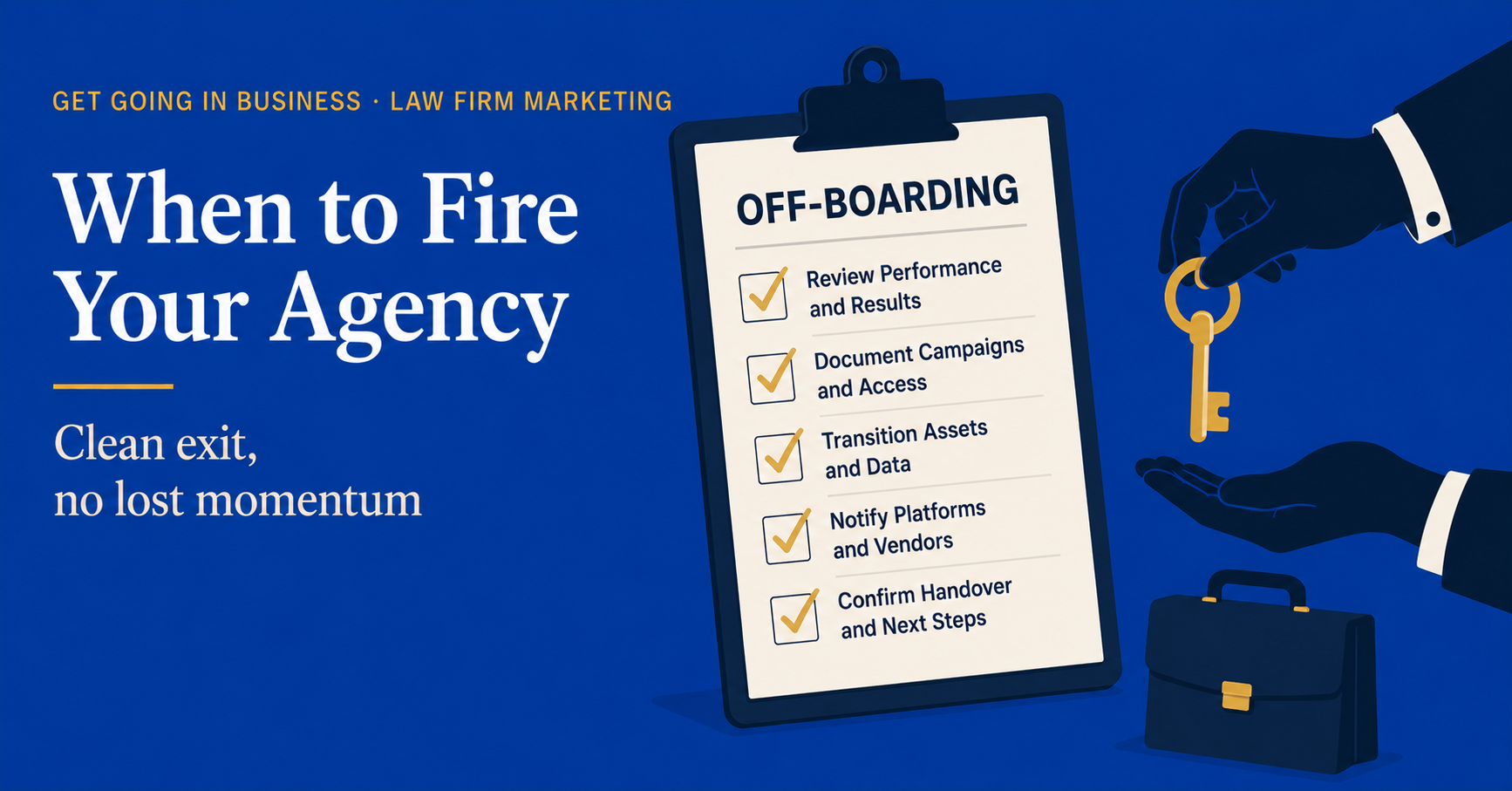
The Off-Boarding Checklist
Once you have decided, the order of operations matters. Many firms get fired-agency surprises (lost accounts, dropped pixels, stolen data) because they handled the off-boarding emotionally instead of procedurally. Do this in order.
Step 1: Get full account access in writing
Before you say anything to the agency, confirm you are the primary admin on every platform: Google Ads, Google Analytics, Google Business Profile, Search Console, Facebook Business Manager, your CRM, your call tracking, your hosting, your domain registrar. If any of these still belong to the agency, request admin transfer in writing as a routine matter, without telling them why.
This is the most common surprise: firing an agency that owns your Google Ads account means losing your account, history, conversion data, and audiences. Get the access first. Always.
Step 2: Export your data
Download everything that is not natively yours. Lead lists from forms. Call recordings from call tracking. Reports for the last 24 months. Campaign performance exports. Asset libraries (ad copy, images, landing page files). If the agency built the website, request the source files. If the agency hosts your site, get a full backup.
Step 3: Review the contract
Read the actual contract. Note the notice period (usually 30 days, sometimes 60 or 90). Note any non-compete or non-solicit clauses. Note what is included in the termination clause: who keeps what, who pays what, what happens to ad spend already committed. Most firms have never read their own contract until this moment. Read it now.
Step 4: Plan the transition before you give notice
Do not give notice without a transition plan. Either you have a new agency lined up, an in-house person ready to take over, or a defined pause period where you will run things yourself or with a contractor. The worst outcome is firing the agency, having no plan, and watching three months of marketing momentum evaporate while you scramble.
Step 5: Give notice in writing
Email, not phone. State the termination date based on the contract notice period. Request specific deliverables before that date: final reports, account access confirmations, asset handoffs, transition support. Do not negotiate. Do not give them an opening to save the relationship. The decision is made.
Step 6: Manage the notice period actively
Agencies on notice often coast. Monitor the campaigns daily during the notice period. Make sure nothing gets paused, nothing gets reassigned, nothing gets quietly deleted. Save all communication. Confirm final deliverables in writing as they are received.
Step 7: Run a clean handoff
On the last day, do a final account access audit. Remove the agency from every platform. Change passwords on shared accounts. Confirm your new team or contractor has everything they need. Send a one-line professional close-out email: “Thanks for the work. Transition is complete.” Move on.
What to Do With the Money You Free Up
Most firms that fire an agency expect to save money. Sometimes that’s right. More often, the smart move is to redirect the same dollars to better-performing channels or to a different kind of marketing investment.
Common reinvestment moves after firing an agency:
- Hire a fractional marketing manager who reports to you instead of a remote agency
- Move the same monthly budget to direct paid acquisition with a specialist contractor
- Reallocate part of the spend to content, SEO, or brand investments the previous agency neglected
- Reinvest in intake training or CRM tooling that the agency repeatedly flagged as the issue but never helped solve
Firing the agency is a chance to rebalance the whole stack. We covered the right allocation framework in our companion guide on law firm marketing budget breakdown. Use the agency exit as the moment to set the new budget intentionally.
Common Mistakes Firms Make When Firing an Agency
Mistake 1: Telling them too early
Firms often signal dissatisfaction for months before formally giving notice. The agency uses that time to either coast or to prepare a counter-offer they did not bother to provide before. Either way, you lose leverage. Decide privately, prepare quietly, give notice cleanly.
Mistake 2: Negotiating mid-notice
Once notice is given, the agency may come back with a fee cut, a new account manager, or a promise to change. A fee cut does not solve poor performance. A new account manager does not change the agency’s systems. Stay decided.
Mistake 3: Firing without a 90-day plan
Marketing momentum lives in the first 90 days post-transition. If you fire without a plan, ads pause, pixels expire, audiences decay, and your pipeline drops 30 to 50 percent within 60 days. Always have the next 90 days mapped before you hand over the keys.
Mistake 4: Burning the bridge publicly
Lawyers talk. Your local legal community is small. Even if the agency truly failed, keep the off-boarding professional. Bad-mouthing them publicly hurts your reputation more than it hurts theirs.
Frequently Asked Questions
How long should I give a new agency before firing them?
Ninety days minimum. The first 30 days are setup and learning. Days 31 to 60 are optimization. Days 61 to 90 should show measurable improvement. If they have not produced clear progress by day 90, they probably will not. If you fire before day 90, you are usually firing the wrong agency for a problem that needed more time.
Can I switch agencies mid-campaign?
Yes, but plan for a transition gap. New agency needs 2 to 4 weeks to get oriented, audit accounts, and start optimizing. During that window, you will typically see a small dip in performance. Budget for it. Do not panic.
Should I tell the new agency why I fired the old one?
Yes, in specifics. The new agency needs to know what failed: was it reporting transparency, campaign neglect, intake blame, slow execution? A good new agency uses that information to set up the relationship differently from the start.
What if the agency built my website? Do I lose it when I fire them?
Depends entirely on the contract. Some agencies retain ownership of websites they built; others hand them over. Read the contract before you give notice. If you do not own the site, request a clean export and migration plan as part of the off-boarding. This is one reason to get account access in writing first.
Get Help Off-Boarding Cleanly
If you have decided your current agency relationship is over but you are not sure how to leave without losing data or momentum, we have walked dozens of firms through this transition. We can review your current setup, build the off-boarding checklist for your specific situation, and help you plan the next 90 days so the change is smooth.
Want help auditing whether it’s time to fire your current marketing agency?
Book your free 15-min strategy call at getgoinginbusiness.com
Related: PPC for Law Firms: How to Know If Your Agency Is Actually Performing →